Partnered with Product to shape the vision for Clari Align’s account planning experience and led the design direction that helped enterprise teams map influence, strengthen relationships, and close strategic deals.


![[digital project] image of a mobile device with a productivity app interface (for a productivity tools business)](/images/1-1-2-Align-small.png)
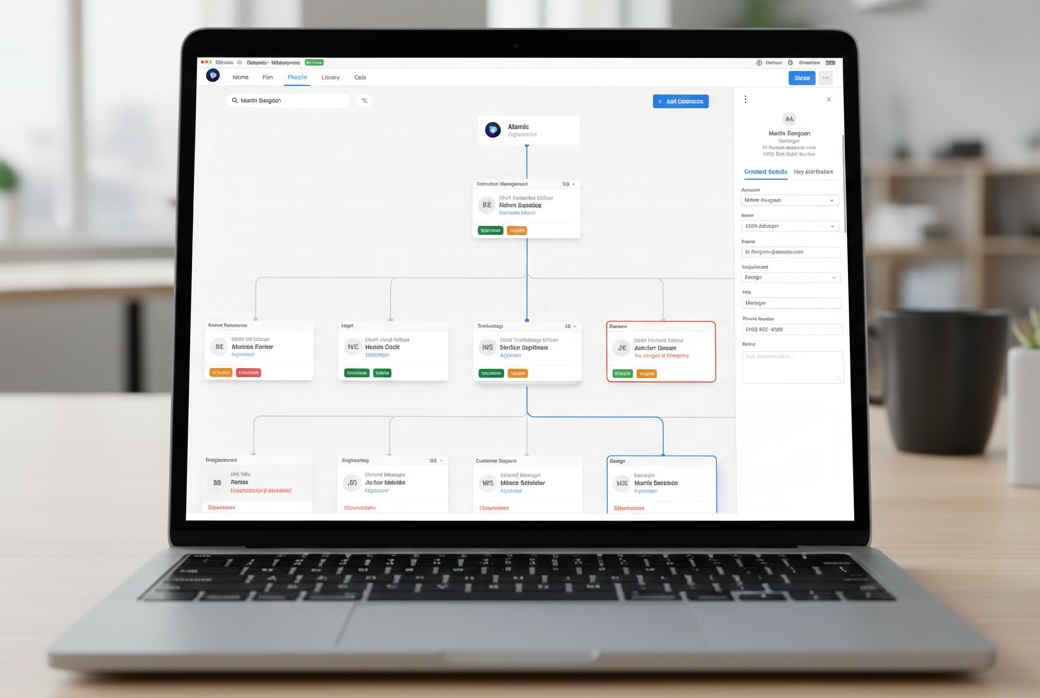
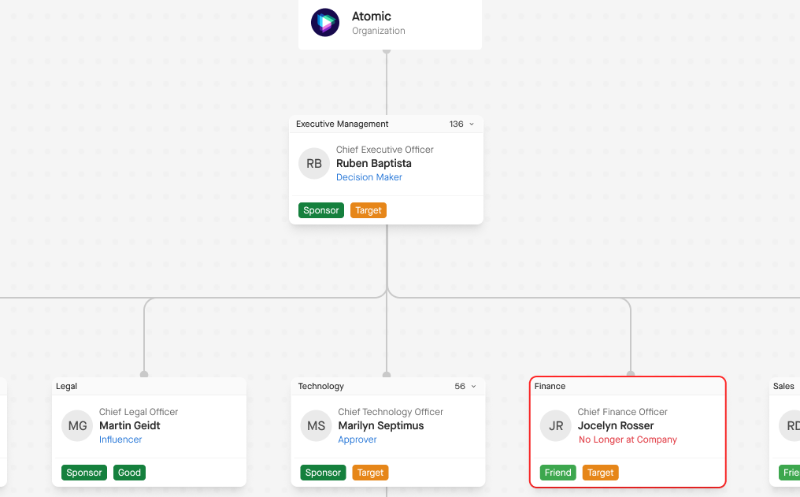
A small set of representative screens showing how the relationship model translated into a usable, enterprise-ready experience. These artifacts demonstrate progression from empty state to enterprise-scale complexity.
As Clari’s platform matured into a comprehensive revenue and sales engagement suite, it became clear that one critical area of enterprise selling remained underserved: account planning and relationship management.
Clari Align is Clari’s mutual action planning product, designed to help sellers and customers align around shared goals, milestones, and next steps. With this work, Align was extended beyond execution planning to support account planning and relationship mapping—making it possible for sales teams to understand complex buying groups, influence, and opportunity directly within the platform.
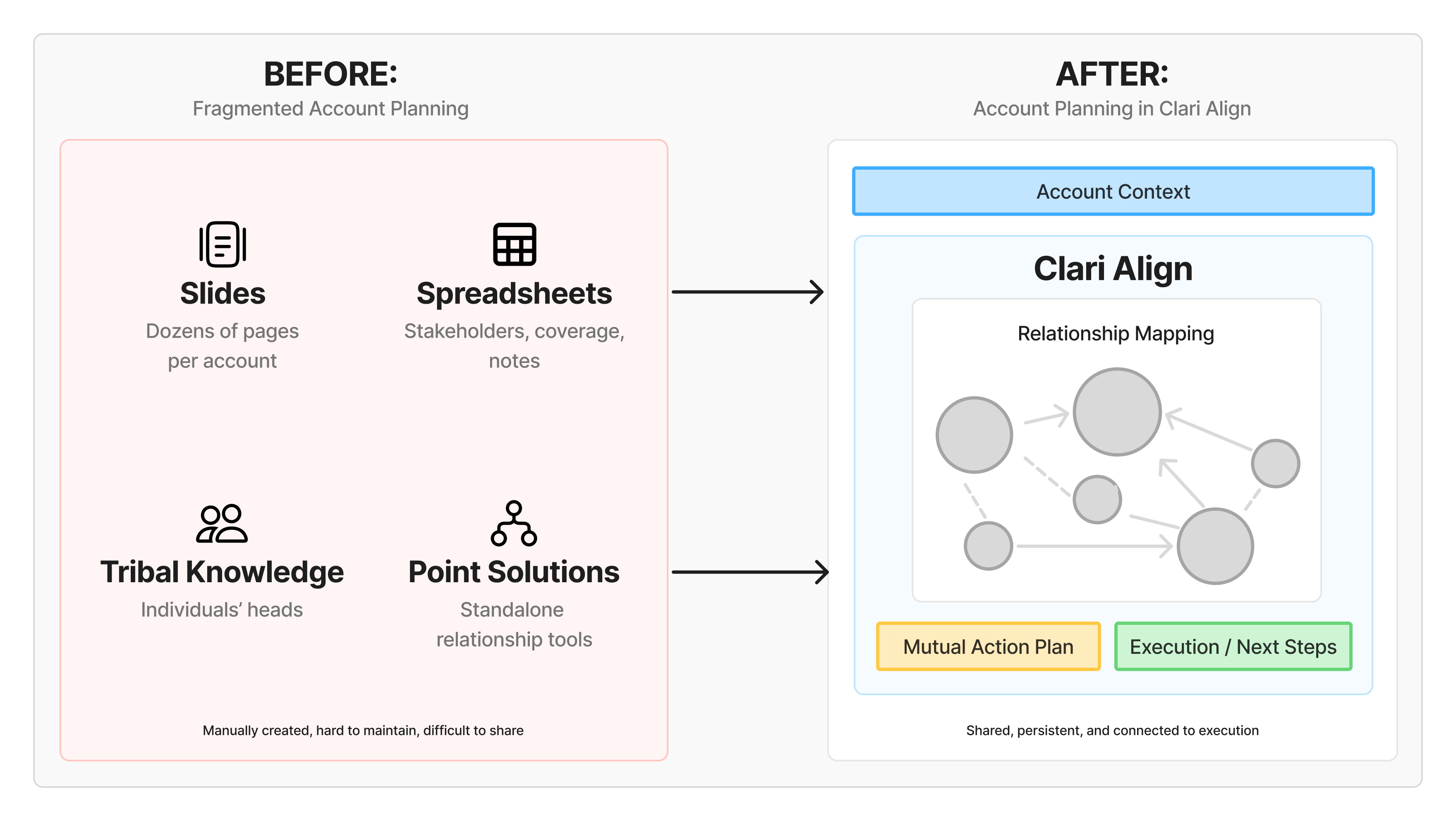
Rather than addressing a friction in existing Clari workflows, this effort expanded the platform into a new, adjacent product area where teams were already compensating with point solutions, spreadsheets, and slide decks. The initial release was intentionally MVP in scope, but grounded in enterprise-first needs and informed by multiple enterprise customers. It positioned Clari to compete credibly in the account planning space while creating a foundation that could evolve into deeper intelligence and tighter platform integration over time. I led this work as a player-coach, combining hands-on design contribution with system-level leadership to ensure quality, scalability, and long-term leverage.
Clari Align was originally built as a mutual action planning product—helping sellers and customers align around shared objectives, milestones, and commitments once a deal was already in motion. While effective for execution, it did not address an earlier and equally critical phase of enterprise selling: account planning.
Account planning is the ongoing practice of understanding a customer organization well enough to guide long-term strategy—who influences decisions, how buying committees are structured, where risk exists, and where future opportunity may lie. In enterprise sales, this work happens long before and well beyond a single deal cycle.
Rather than being unsupported entirely, account planning was already happening—just not inside Clari.
Enterprise teams relied on a combination of:
These tools solved pieces of the problem, but they lived outside the core sales workflow. Relationship context was static, difficult to keep current, and rarely connected to execution data. Insights were often rebuilt repeatedly and shared inconsistently across teams.
This opportunity became especially concrete through a design partnership with a Fortune 500–scale enterprise customer, whose sales teams treated account planning as a formal discipline. For each strategic account, they created extensive slide decks—often dozens of pages long—that documented:
While this partnership provided rich, real-world grounding, it was not treated as a one-off requirement. Similar patterns surfaced across other enterprise customers, reinforcing that this was a category-level need, not a bespoke request.
The stakes were strategic:
This work was not about fixing a broken experience. It was about expanding the platform into a new domain in a way only an integrated system could—starting with enterprise complexity and designing forward toward a more complete, connected model of strategic selling.
This work began in a deliberately small, senior configuration before expanding into a focused delivery model as scope and confidence increased.
At the outset, the effort was driven by the Product Manager for Clari Align and me, working closely together to explore whether account planning and relationship mapping represented a viable extension of the product. At this stage, the work was primarily strategic—framing the problem space, pressure-testing assumptions, and sketching early experience models in close partnership with a Fortune 500–scale enterprise customer acting as a design partner.
In parallel, the Product Manager coordinated with the customer’s account team to formalize a commercial engagement that allowed us to build and validate an initial MVP. While the commercial details were handled outside design, this context shaped how we approached the work: we needed to move quickly, demonstrate credibility at enterprise scale, and ensure the solution was not narrowly tailored to a single customer’s needs.
As part of this collaboration, I regularly represented design in leadership-level conversations with the design partner—asking targeted questions, validating assumptions, and using real-world scenarios to refine how account planning and relationship mapping needed to function in practice. These discussions helped ensure the experience reflected enterprise reality rather than theoretical workflows.
As the work moved toward formal execution, I expanded the team intentionally and briefly, bringing in two additional product designers to accelerate exploration. Their focus was to extend early concepts, explore alternative approaches, and move the work rapidly from low-fidelity thinking into high-fidelity concepts for review with the design partner and a small set of other enterprise customers. During this phase, I remained hands-on—contributing to early designs, guiding structure and hierarchy, and ensuring alignment with the broader platform direction.
Once the contract was executed and the core direction validated, I transitioned the work into a more durable delivery model. I assigned a single product designer to own the day-to-day design execution, with me operating as a player-coach throughout the remainder of the project.
In this phase:
While I did not contribute designs directly in Figma during this stage, I stayed close to the work—pressure-testing decisions, resolving trade-offs, and ensuring the solution continued to serve enterprise needs while remaining extensible over time.
This operating model persisted through launch. It allowed us to move quickly early, then shift toward sustainable execution without creating dependency or bottlenecks. Most importantly, it ensured the work benefited from senior judgment at critical moments while enabling a product designer to fully own and grow with a complex, high-stakes product area.
The mandate for this work was not framed as a narrow usability problem or a request to replicate an existing point solution. Instead, it emerged from a broader strategic question: how Clari should evolve as a revenue and sales engagement platform to better support enterprise selling.
At a high level, the ask was to extend Clari Align beyond mutual action planning to support account planning and relationship mapping. But it quickly became clear that success would depend less on feature completeness and more on whether the platform could credibly enter a new domain without fragmenting the overall experience.
Account planning already had an ecosystem of solutions. Enterprise teams were using standalone tools, CRM extensions, spreadsheets, and slide decks to reason about relationships, influence, and opportunity. Competing directly on depth alone would have required building a specialized tool disconnected from Clari’s core strengths. The real opportunity—and the risk—was determining how account planning could live inside an integrated revenue platform in a way that other solutions could not.
This reframed the mandate:
At the same time, scope discipline mattered. The initial release needed to be focused enough to ship, while still establishing the right foundations.
Explicit non-goals for the first release:
Instead, the goal was to define the core relationship model and interaction patterns that could support enterprise account planning while remaining extensible.
Success was evaluated along three dimensions:
This was not measured by short-term adoption or feature parity. The success test was whether Clari could credibly expand into account planning as a product area, using Align as the foundation, and do so in a way that competitors focused on single-purpose tools could not easily replicate.
Through early exploration, leadership discussions with enterprise partners, and validation across multiple customers, several patterns emerged that fundamentally shaped how account planning and relationship mapping needed to work inside Clari Align. These insights went beyond surface usability and directly informed the underlying model, not just the interface.
Enterprise teams did not treat account plans or relationship maps as one-time deliverables. Buying groups shifted, priorities changed, and influence moved as deals progressed. Yet most existing tools—and nearly all slide-based workflows—produced static snapshots that were outdated almost as soon as they were created.
Design implication:
The experience needed to support partial, evolving knowledge. We optimized for updating and reasoning over time, rather than completeness or visual polish. This pushed us toward interaction patterns that made change feel lightweight and expected, not exceptional.
While org charts provided a useful starting point, enterprise sellers consistently emphasized that titles alone were a poor predictor of decision-making power. Informal influence, cross-functional relationships, and non-obvious stakeholders often mattered more than formal reporting lines.
Design implication:
Relationship mapping could not be treated as a simple organizational diagram. The model needed to emphasize connections, strength, and relevance, allowing teams to reason about influence without overloading the UI with unnecessary structural detail.
Teams were already documenting relationships thoroughly—in spreadsheets, notes, and slide decks. The problem wasn’t lack of effort; it was that relationship information rarely translated into action once planning transitioned into execution.
Design implication:
The relationship map needed to function as a decision surface, not a repository. We prioritized clarity, signal, and navigability over exhaustiveness, ensuring that insights gathered during planning could meaningfully inform downstream sales motions.
In multiple enterprise scenarios, critical stakeholders existed outside the immediate organizational hierarchy—board members, partners, executive sponsors, or adjacent teams influencing outcomes indirectly. These relationships were often captured manually in slides because existing tools couldn’t represent them cleanly.
Design implication:
The underlying relationship model had to be extensible. Even though the initial MVP focused on core org-level relationships, the system needed to anticipate broader contexts without requiring redesign. This influenced how entities, connections, and metadata were structured from the start.
Collectively, these insights reframed the problem. Relationship mapping inside Clari Align was not about creating better diagrams—it was about enabling enterprise teams to reason about complexity, uncertainty, and influence in a way that could evolve over time and integrate naturally into a broader revenue platform.
The insights from enterprise customers made one thing clear: success would not come from building the most feature-rich relationship mapping tool. It would come from embedding account planning into Clari’s platform in a way that preserved strategic signal, supported enterprise complexity, and scaled forward without fragmentation.
The core strategy was to treat account planning and relationship mapping as a platform capability, not a standalone destination.
Rather than competing directly with point solutions optimized for depth in isolation, Clari Align would:
This meant prioritizing coherence and extensibility over immediate completeness. The first release needed to feel credible for enterprise teams while remaining intentionally constrained—proving the model before expanding the surface area.
Enable enterprise sales teams to reason about complex buying groups quickly, confidently, and collaboratively—without leaving the platform.
This north star reframed the experience away from documentation. The goal was not to capture every possible detail, but to help teams answer essential questions:
The relationship map became a thinking tool, not an artifact to be perfected.
These tenets guided every major decision, from the underlying relationship model to individual interaction patterns.
One early option was to build a deep, visually rich relationship visualization—closer to what many standalone tools offer. While compelling in isolation, this approach failed against the tenets. It emphasized diagram fidelity over decision-making, increased maintenance cost, and risked becoming a siloed feature rather than a platform capability.
Choosing not to pursue this path allowed the team to stay focused on foundational value: delivering an MVP that enterprise teams could trust and that Clari could build on without rework.
The design approach focused on establishing a clear experience architecture and relationship model that could support enterprise account planning immediately, while remaining flexible enough to evolve into a broader intelligence layer over time.
Rather than starting with screens, the work began by defining what needed to be true for an enterprise seller to reason effectively about an account. This framing helped avoid the common trap of designing a visually impressive map that failed to support real decision-making.
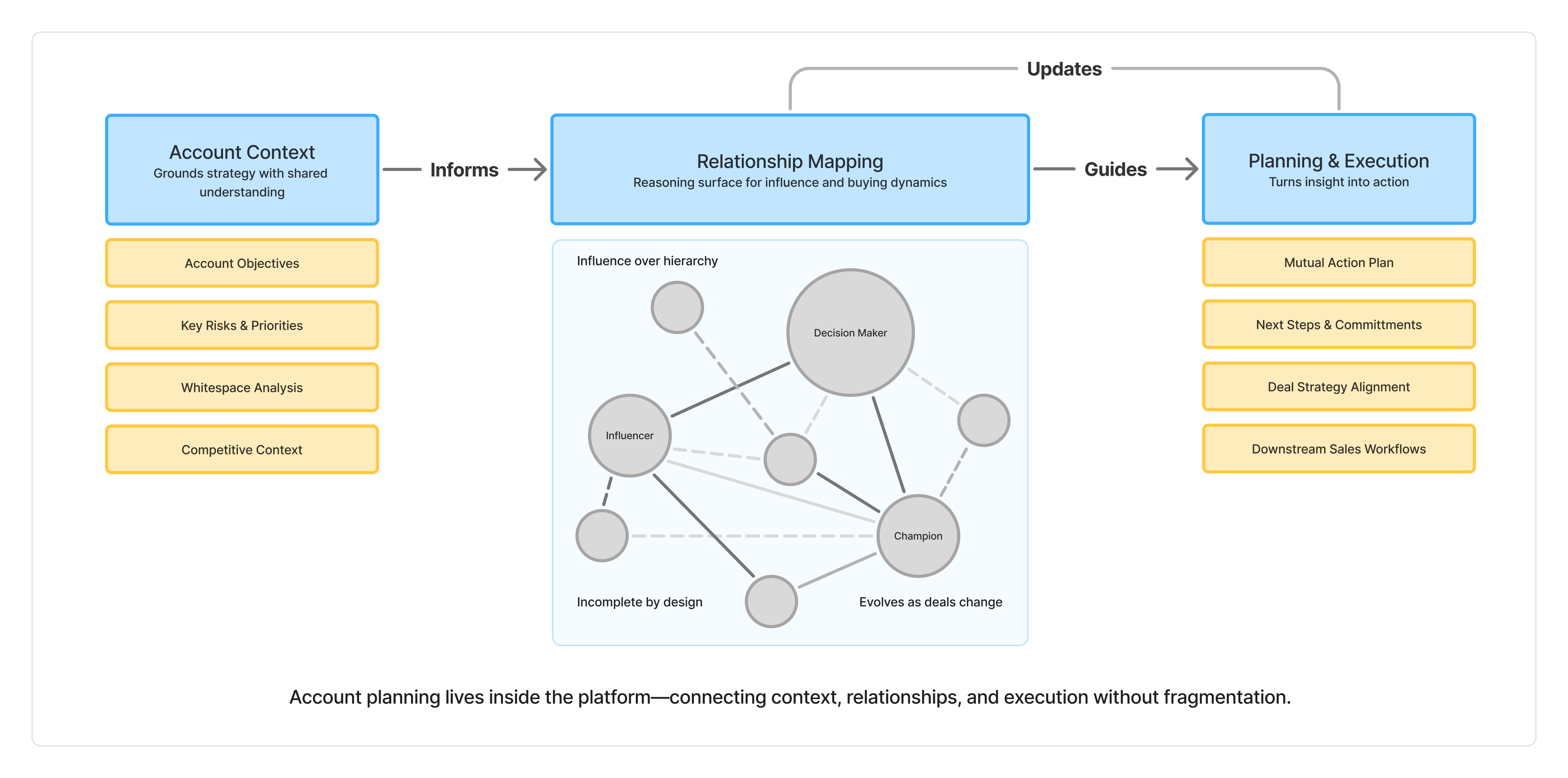
At a high level, the experience was structured around three core layers:
This architecture ensured the relationship map functioned as a thinking surface, not a dead-end visualization.
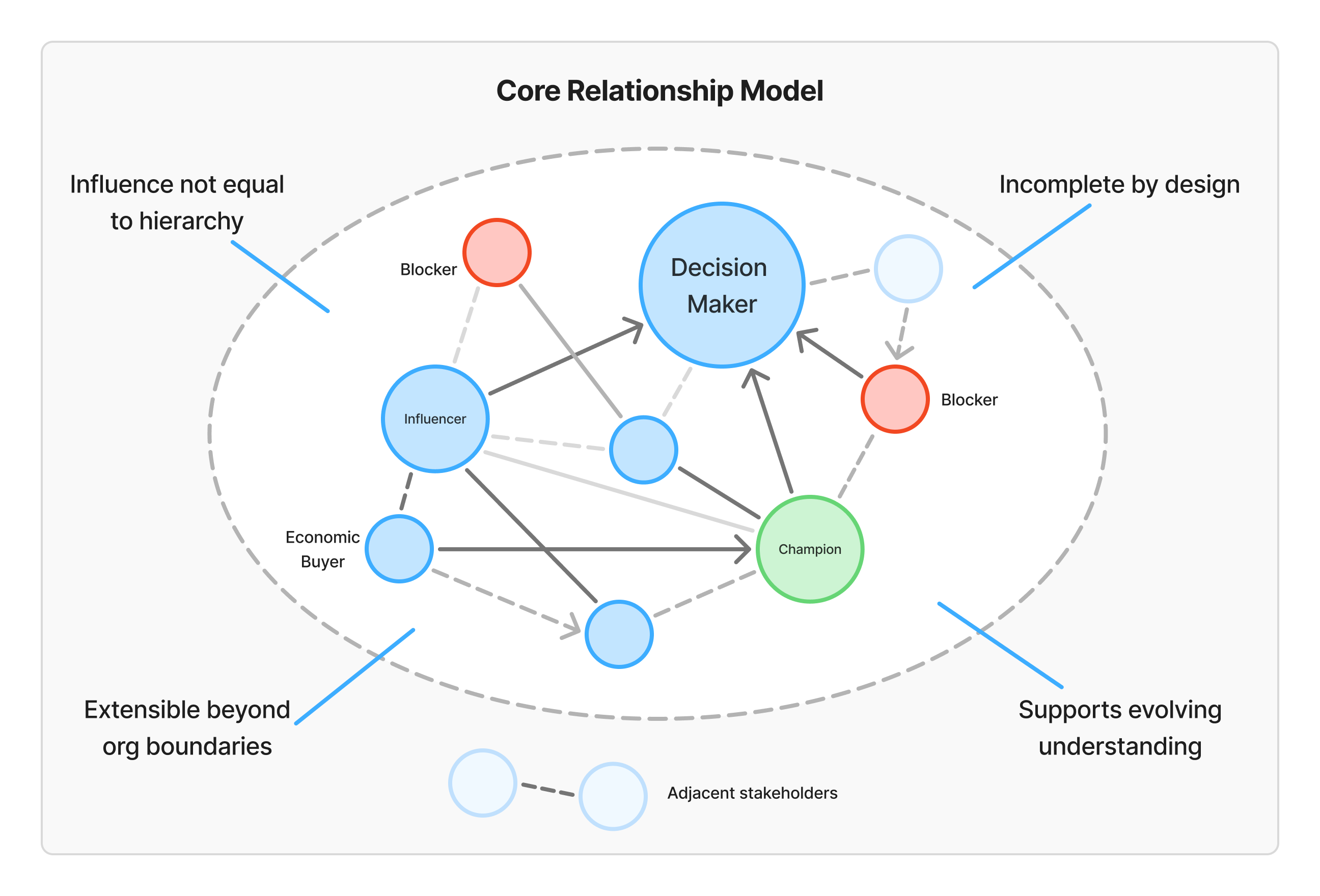
A critical design decision was to keep the initial relationship model intentionally constrained.
The MVP focused on:
This constraint was deliberate. It allowed the experience to remain legible and usable in enterprise scenarios, while creating room to extend into:
The goal was not to model everything immediately, but to model the right things well.

A typical interaction flow looked like this:
This flow prioritized speed to understanding over configuration or customization.
Several design decisions carried disproportionate impact:
Accessibility and clarity were treated as baseline requirements, not afterthoughts—particularly important given the density and complexity of enterprise accounts.
Some capabilities were intentionally deferred to protect the integrity of the initial release:
These were not omissions; they were sequenced decisions. The underlying model anticipated these needs without forcing premature surface complexity.
The result was an experience that felt purposeful rather than exhaustive—credible for enterprise teams today, and structurally prepared for expansion tomorrow.
The screens below illustrate how the account planning and relationship mapping strategy translated into a usable, enterprise-ready experience inside Clari Align. Rather than presenting a full UI walkthrough, these examples focus on representative moments that demonstrate platform integration, MVP scope discipline, and how the relationship model holds up from an empty state through enterprise-scale complexity.
The emphasis here is on how the experience supports reasoning: moving from account context into relationship understanding, progressively enriching that understanding, and scaling to dense buying groups without overwhelming the user.
Final execution designs were created by a product designer on my team; my role focused on experience strategy, critique, and design quality throughout delivery.
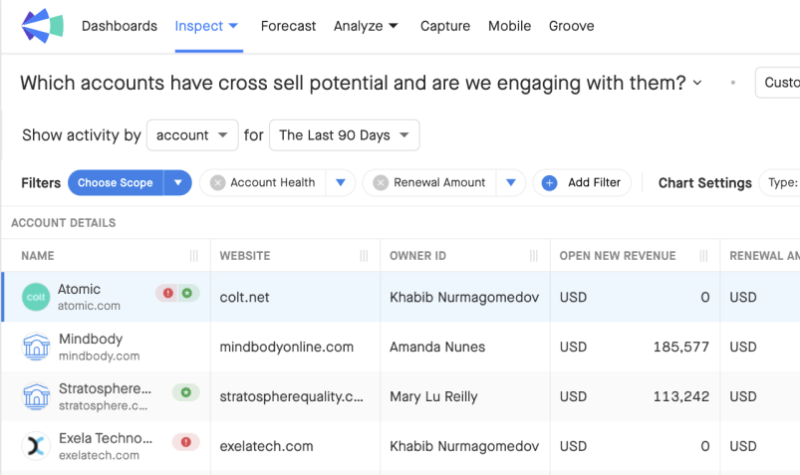
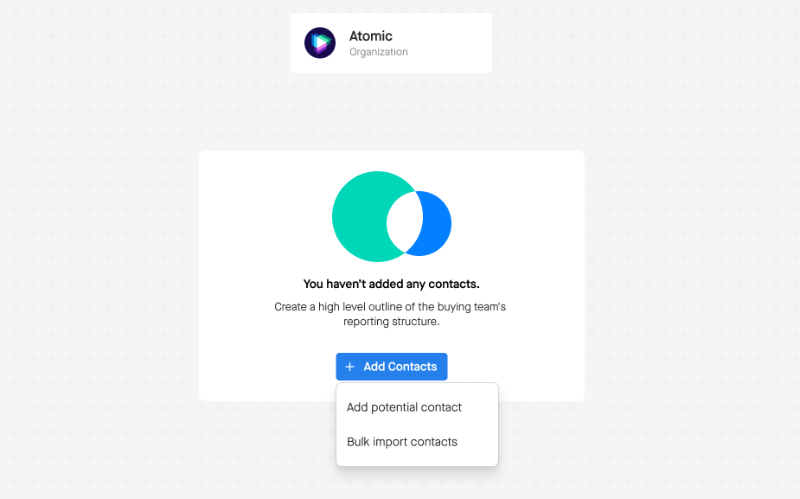
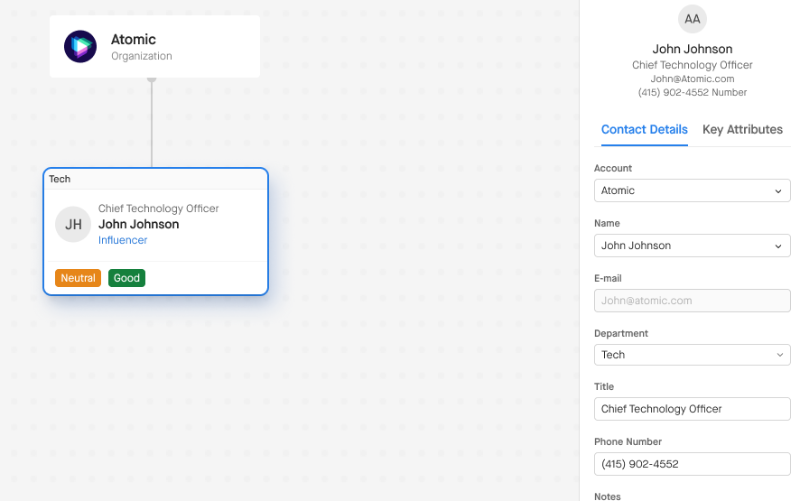
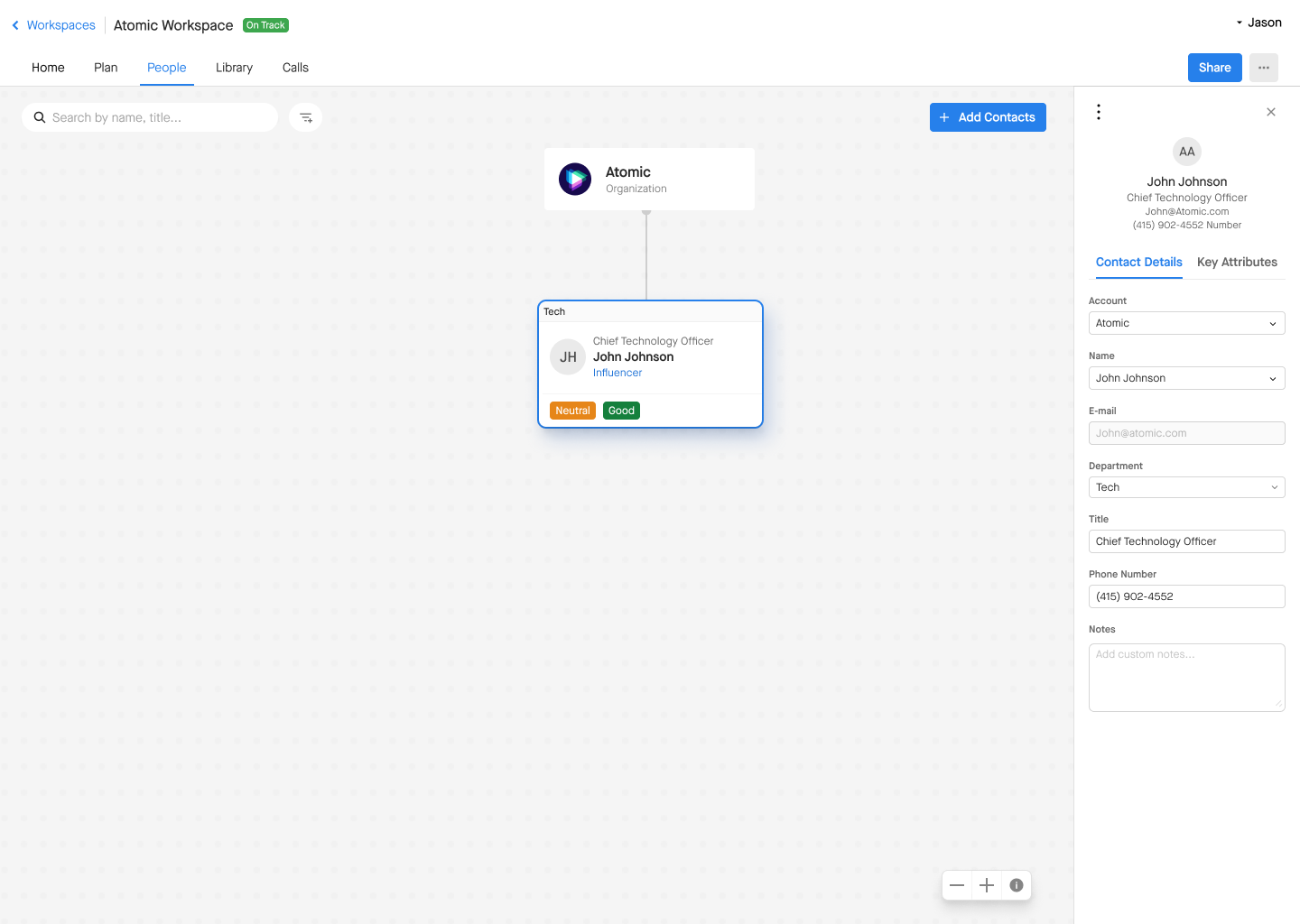
This flow demonstrates how relationship mapping begins from a blank state and progressively gains meaning as sellers add and refine account knowledge. The focus is on reducing friction early, supporting partial understanding, and allowing detail to emerge over time without disrupting the broader account planning workflow.
Relationship mapping is accessed directly from Clari Inspect, grounding the experience in an active account and reinforcing that this work lives inside the platform—not as a standalone tool or disconnected workflow.
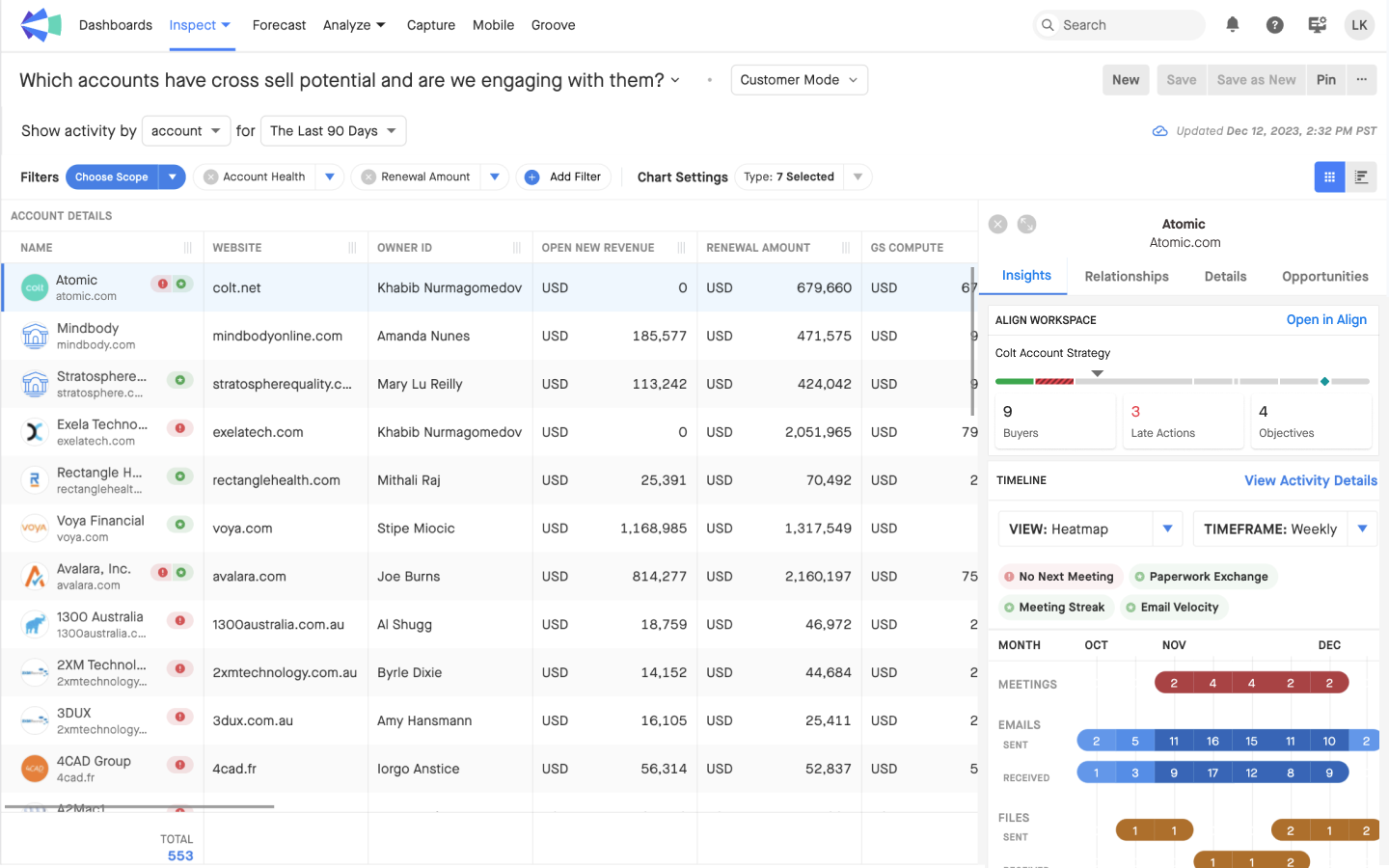
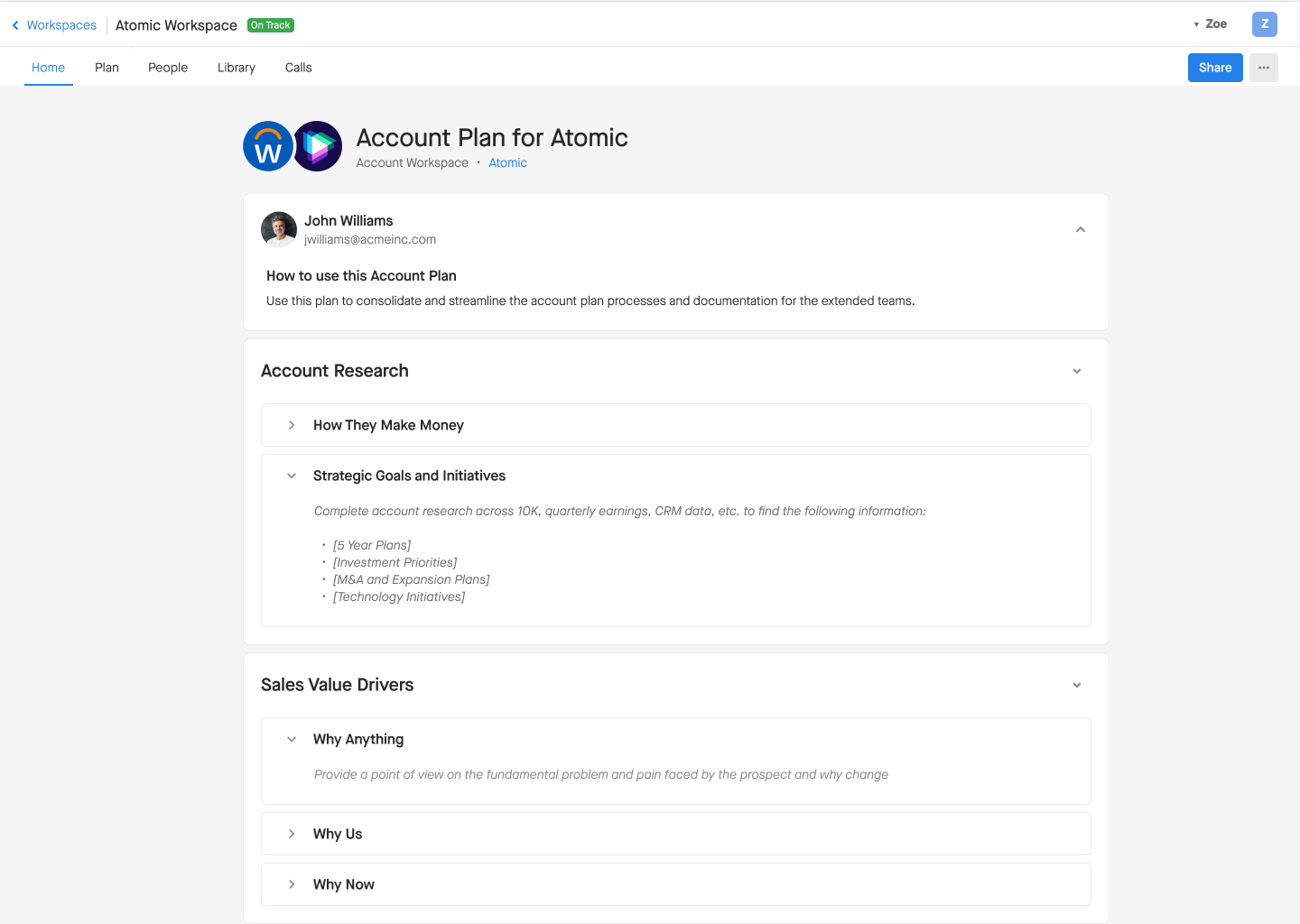
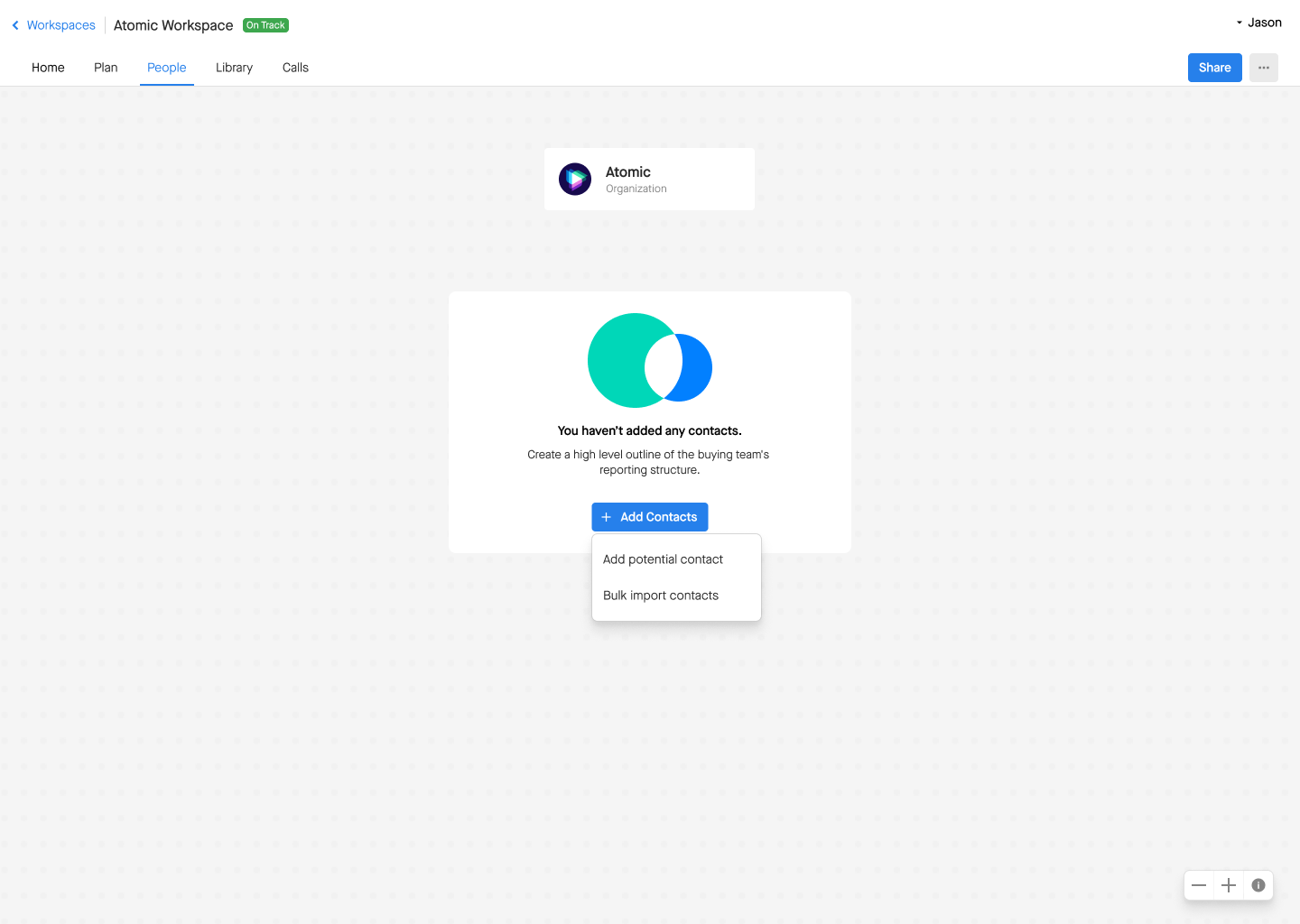
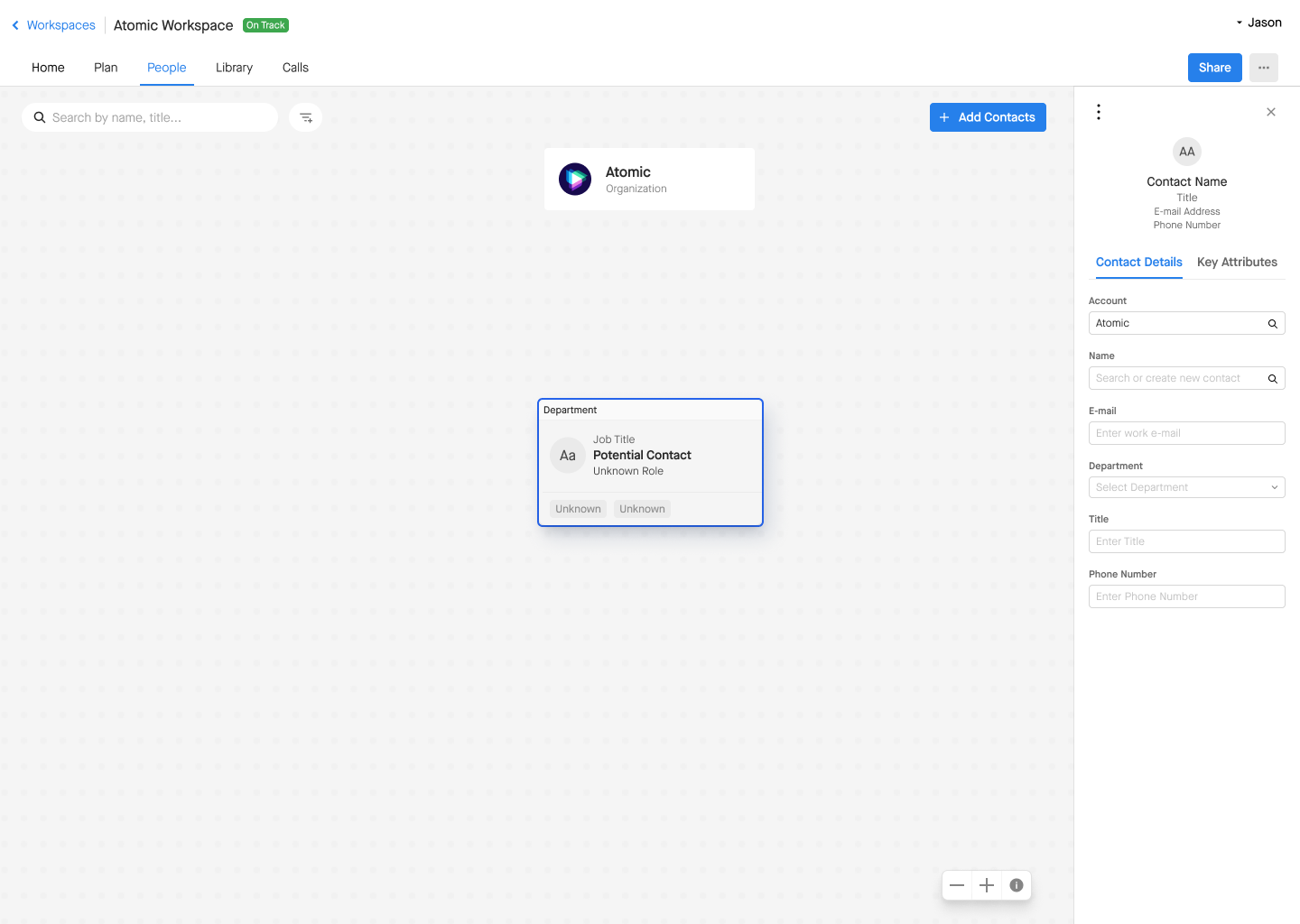
As account knowledge matures, the relationship model supports seamless progression from exploratory placeholders to confirmed stakeholders.
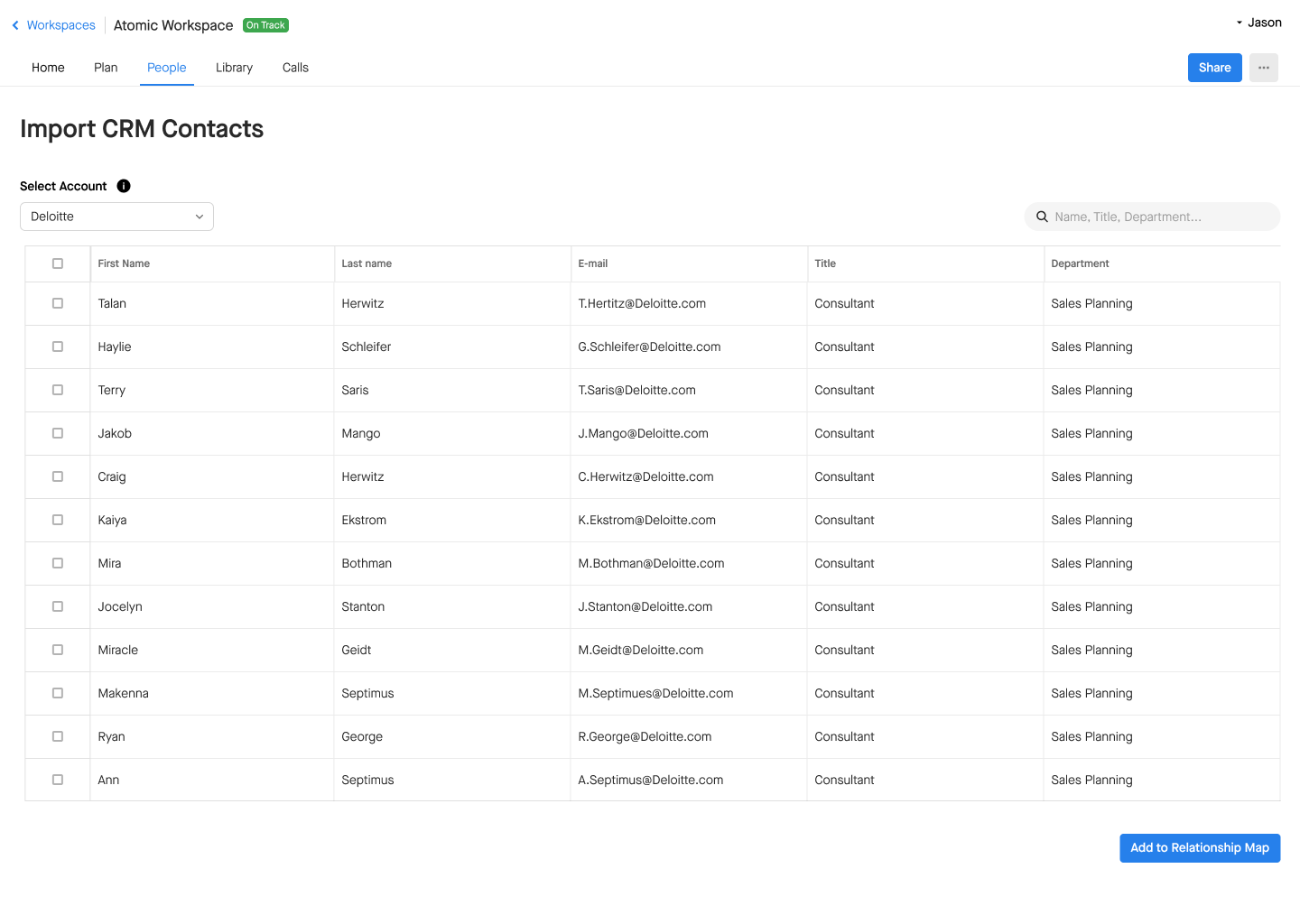
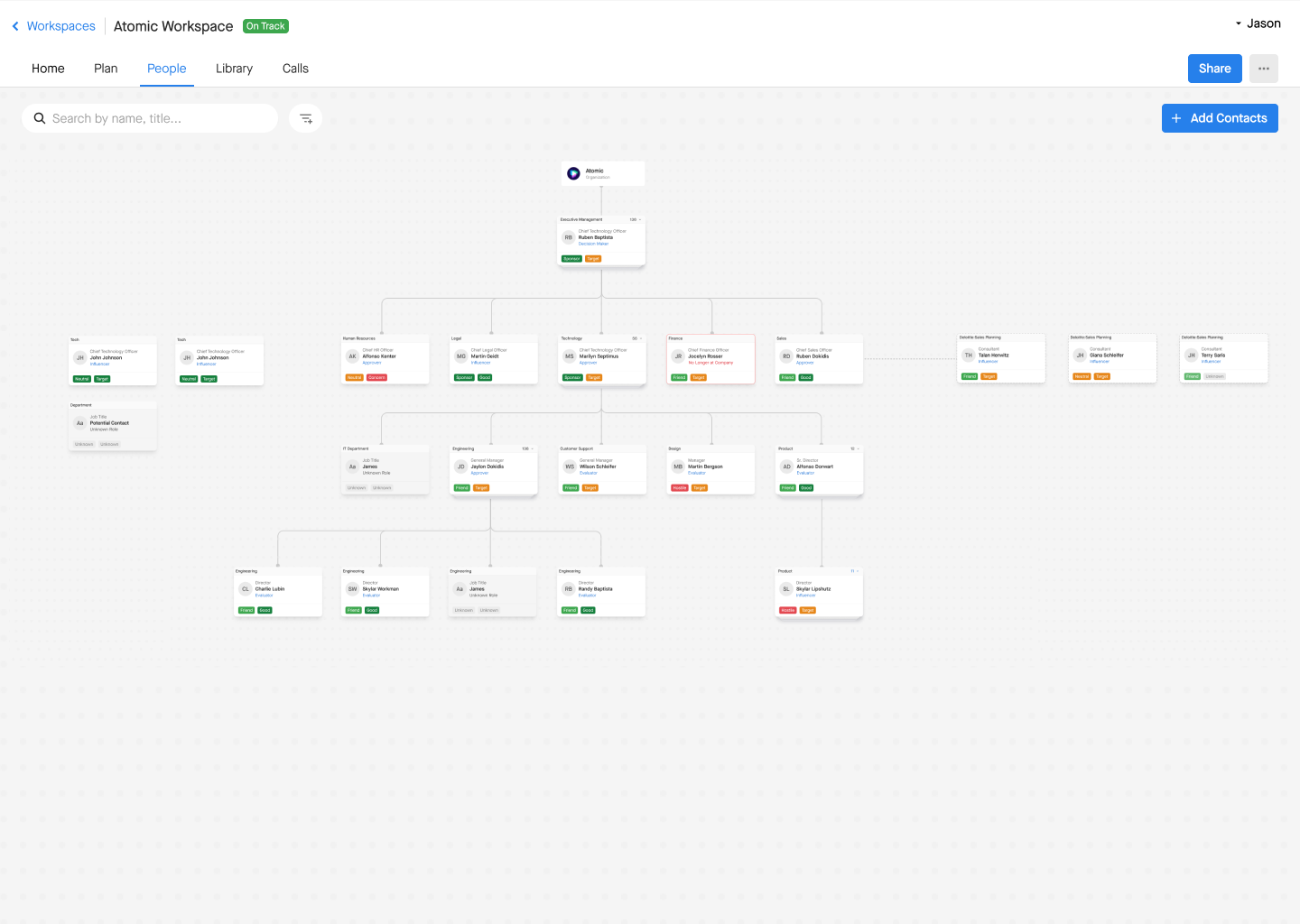
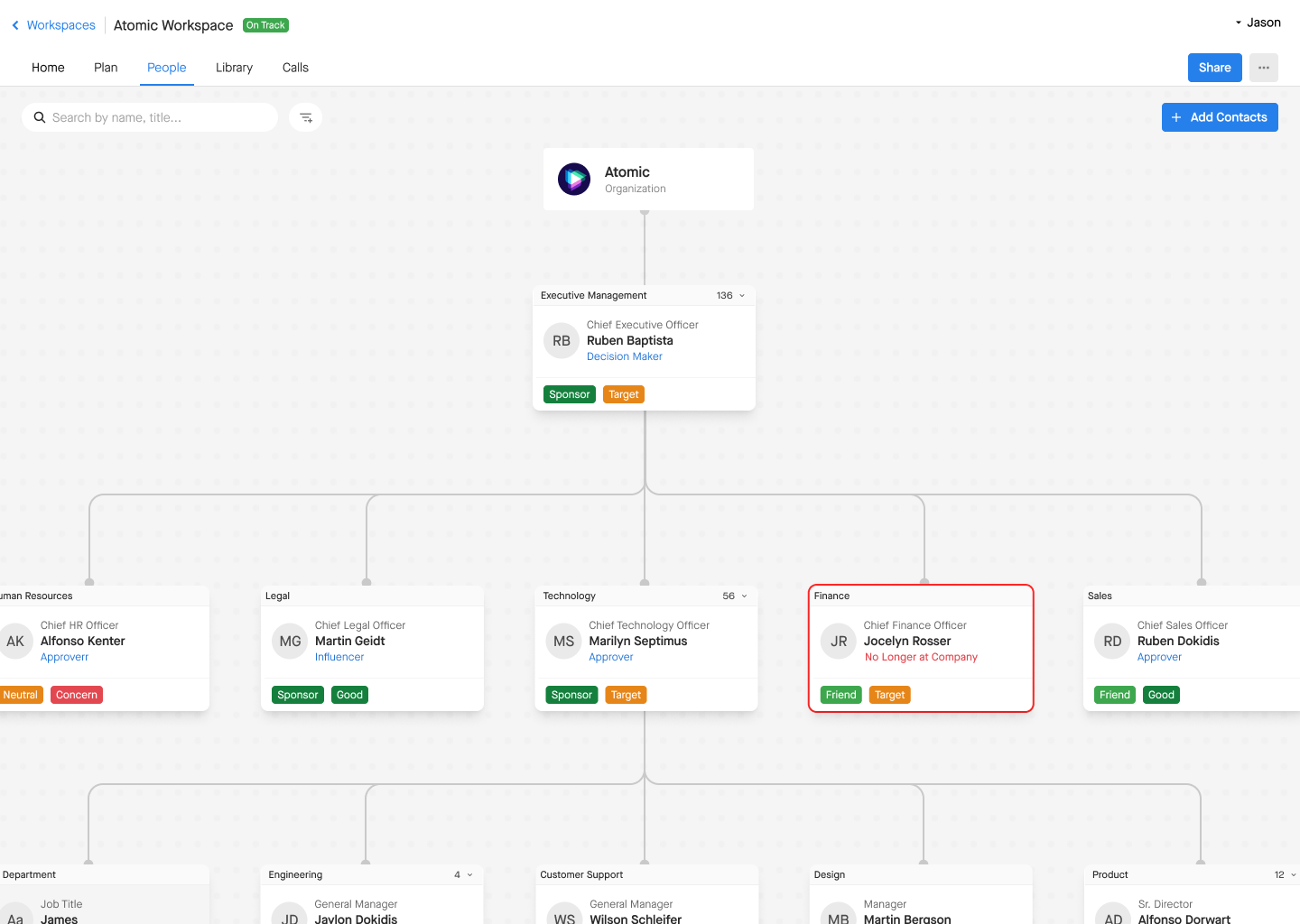
While the first prototype focuses on building relationship context from scratch, this second flow demonstrates how the experience scales when enterprise accounts are initialized with a large volume of contacts. The goal here is not to show every interaction, but to prove that the underlying relationship model and interaction patterns remain legible and usable under density.
These screens illustrate how bulk import accelerates setup for complex accounts, while zooming, selection, and focus states allow sellers to reason about influence and coverage without losing orientation or control.
Given the strategic importance of opening a new product area, delivery was approached as a risk-managed rollout, not a single launch moment. The goal was to ship a credible MVP while protecting experience integrity and preserving room to evolve the model over time.
The work progressed in clear phases, each designed to burn down a different type of risk:
To maintain quality under MVP constraints, several safeguards were built into the operating model:
One of the highest-risk decisions in the project—the underlying technology used to render and support the relationship map—was owned by engineering, but design played an active role in evaluation.
Design participated in reviewing proofs of concept and assessing whether proposed technical approaches could support:
While the final decision was not design-owned, this collaboration helped ensure the chosen approach aligned with experience needs rather than constraining them after the fact.
By combining phased delivery with explicit quality safeguards, the team was able to ship a focused MVP that met enterprise expectations without locking the product into brittle decisions. More importantly, it ensured the experience could evolve deliberately, building on a stable foundation rather than accumulating design debt.
The success of this work was not defined by short-term feature adoption alone, but by whether Clari could credibly enter account planning and relationship mapping as a product area, and do so in a way that strengthened the broader platform rather than fragmenting it.
Because the initial release was positioned as foundational, outcomes were evaluated through a combination of experience signals, enterprise behavior, and platform-level business impact.
Together, these outcomes demonstrate that the work succeeded not by maximizing surface area, but by establishing trust with enterprise users, with internal teams, and with the platform’s long-term direction.
Account planning represented a meaningful expansion of Clari Align’s scope, with no clear precedent inside the platform. I helped align product, design, and engineering early around what problem we were actually solving—framing the work as a platform capability rather than a feature request. This shared framing allowed teams to make consistent decisions even as scope and details evolved.
Rather than chasing feature parity with standalone tools, I advocated for a constrained MVP that established the right foundation. This meant explicitly deferring capabilities that were valuable but premature, and protecting the experience from incremental complexity that would have compromised clarity and extensibility.
By transitioning from hands-on contribution to a player-coach model, I enabled a product designer to fully own a complex, enterprise-facing product area. Through critique, pair-design sessions, and ongoing feedback, I focused on upleveling judgment and confidence rather than directing execution—resulting in stronger outcomes and a more resilient team.
If revisiting this work, I would invest earlier in lightweight instrumentation around how enterprise teams referenced and returned to relationship context over time. While qualitative signals and partner feedback validated the experience, having earlier behavioral metrics—such as revisit patterns or change frequency—would have strengthened confidence in prioritization and sequencing decisions.
I would also look to introduce limited export or sharing capabilities sooner, even in a constrained form, to better support enterprise communication workflows without undermining the core in-product experience.