Defined the vision and prototype for the AE Workspace — a unified, AI-driven experience that now anchors the post-merger sales engagement platform strategy.


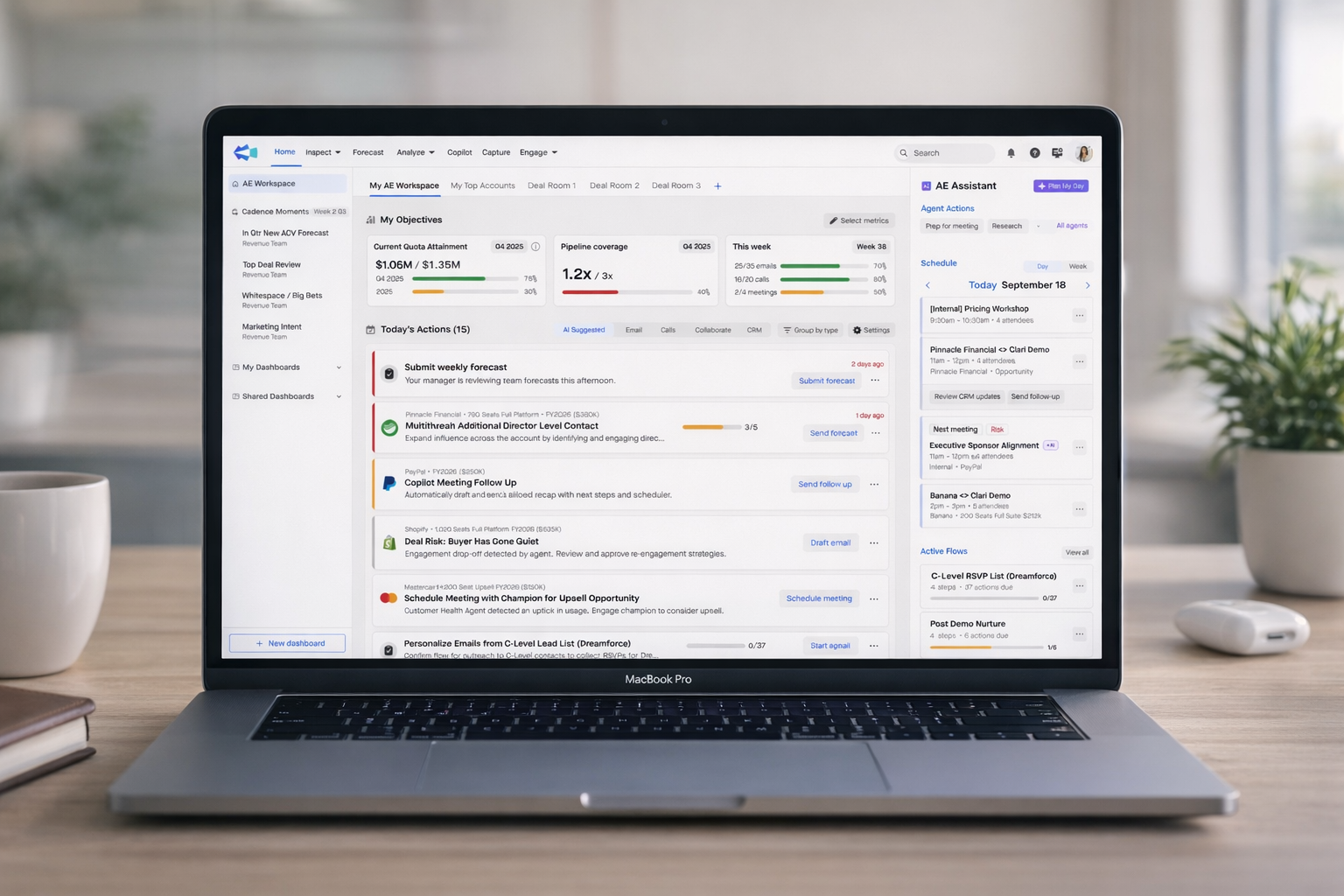
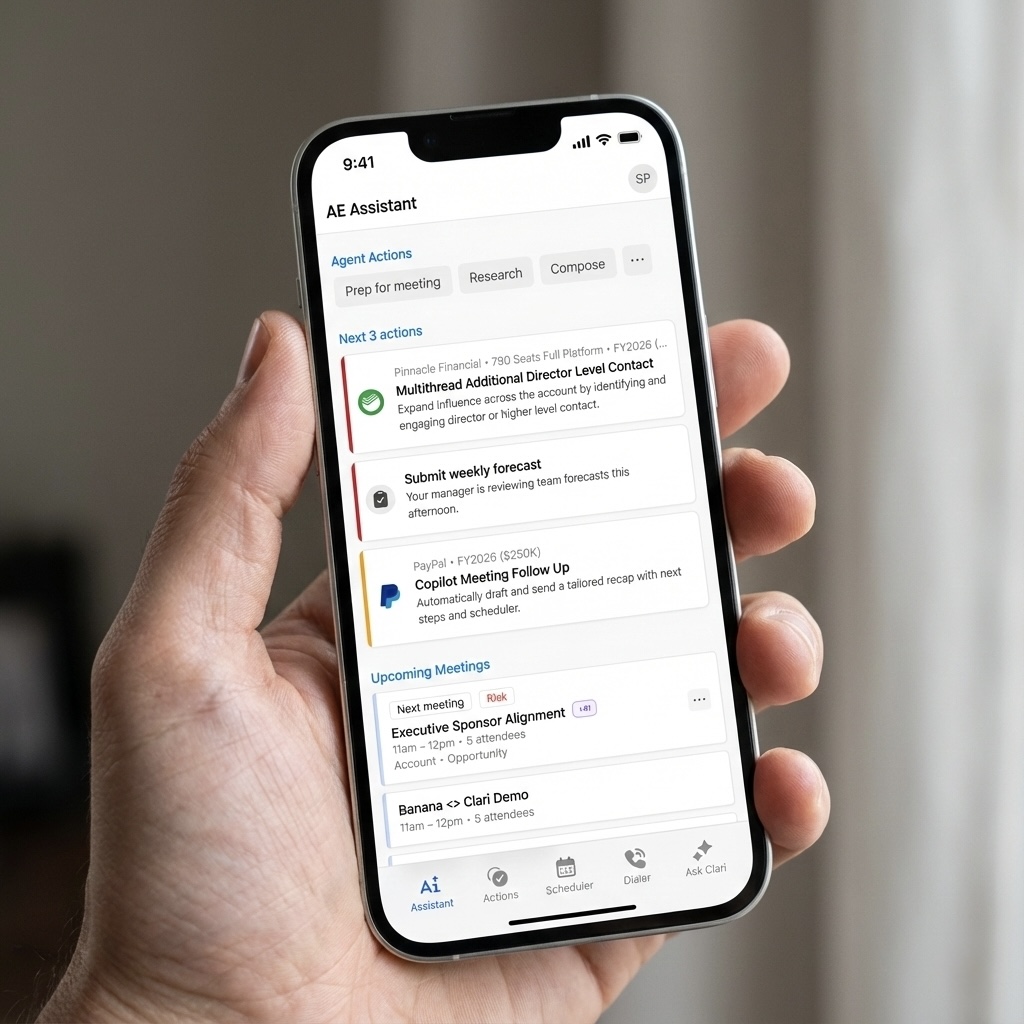
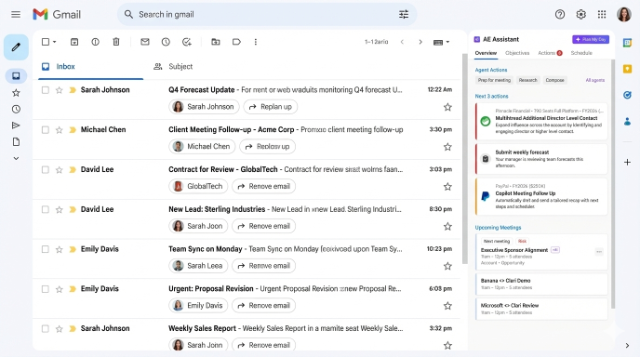
A small set of representative screens showing how the relationship model translated into a usable, enterprise-ready experience. These artifacts demonstrate progression from empty state to enterprise-scale complexity.
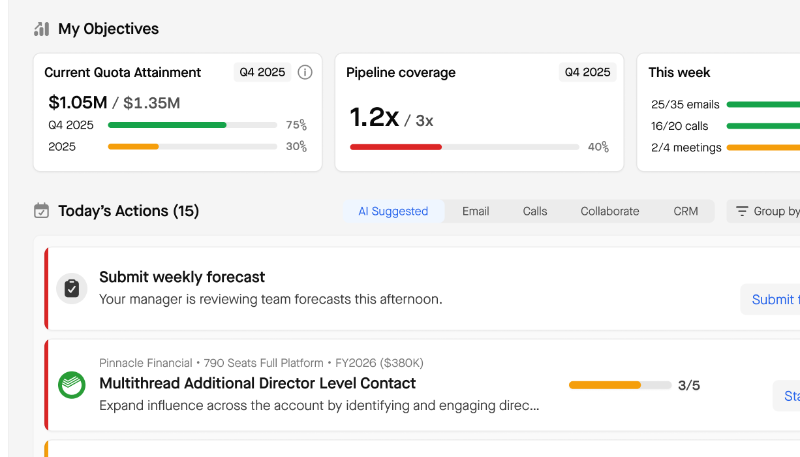
In mid-2025, I led a three-week initiative to define the AE Workspace—a unified, action-first “sales cockpit” adopted as the North Star vision for the Clari/Salesloft product ecosystem post-merger. Before this work, Account Executives (AEs) were forced to switch constantly between disjointed platform tools—Groove (a sales engagement tool) for actions, Copilot for calls, Align for mutual plans and account planning, and Clari Core for inspection and forecasting. The AE Workspace consolidated the most important daily workflows into one adaptive view where reps could prepare for meetings, access contextual insights, and take both internal (forecasting, pipeline updates) and external (calls, emails, outreach) actions without leaving the surface.
Strategically, the work signaled a shift toward elevating the sales-rep persona as a first-class customer instead of designing primarily for leadership and revenue operations (RevOps). My unique leverage came from combining AI-assisted research synthesis with high-fidelity, multi-surface design—web, extension, and mobile—to articulate an actionable and intuitive future vision leadership could immediately align around.
The Clari product organization entered this effort amid major transformation. A new VP of Product from competitor Outreach brought a strong persona-first perspective and was rethinking the sales engagement product organization around cross-functional journeys. At the same time, the merger with Salesloft created urgency to define how two sales-engagement ecosystems would unify. Competition from Gong intensified the stakes; their AI-driven workflows and integrated UI were winning deals where Clari lacked a cohesive Account Executive (AE) experience.
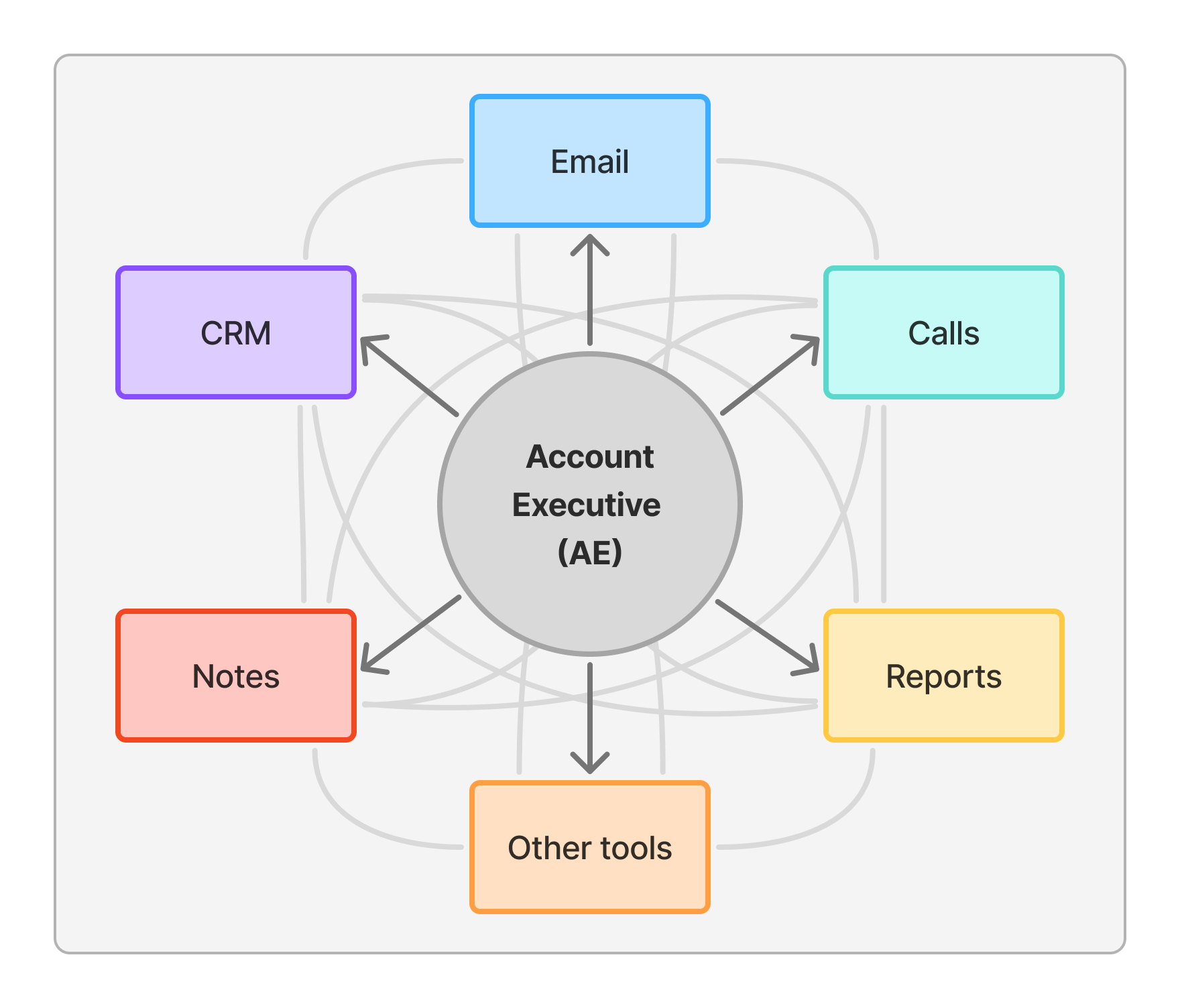
AEs consistently felt underserved. Groove, though acquired to strengthen Clari’s sales-engagement story, had not been unified across the platform. Guide (a product marketing name given to the new “homepage”), was optimized for manager and Revenue Operations (RevOps) inspection, not daily AE execution. Sales reps repeatedly told us, “I just want to know exactly what I need to do next.” The Revenue Orchestration (RO) Workspace, positioned as a reporting and inspection-oriented environment used for deeper analysis, “checked the box” but did not reflect how AEs actually worked.
From the outset, we framed the problem as a separation of modes. The AE Workspace supports fast, action-oriented daily flow, while RO Workspace remained optimized for deeper inspection, analysis, and reporting. This distinction became foundational to the experience model and informed every structural decision that followed.
If we didn’t intervene, Clari risked continuing to invest heavily in the RO Workspace effort without addressing core AE needs. In a post-merger landscape where Salesloft is deeply aligned with sales-rep workflows, this misalignment could have widened experience gaps and reduced competitive credibility.
This work was delivered through a tightly aligned, cross-functional leadership pod:
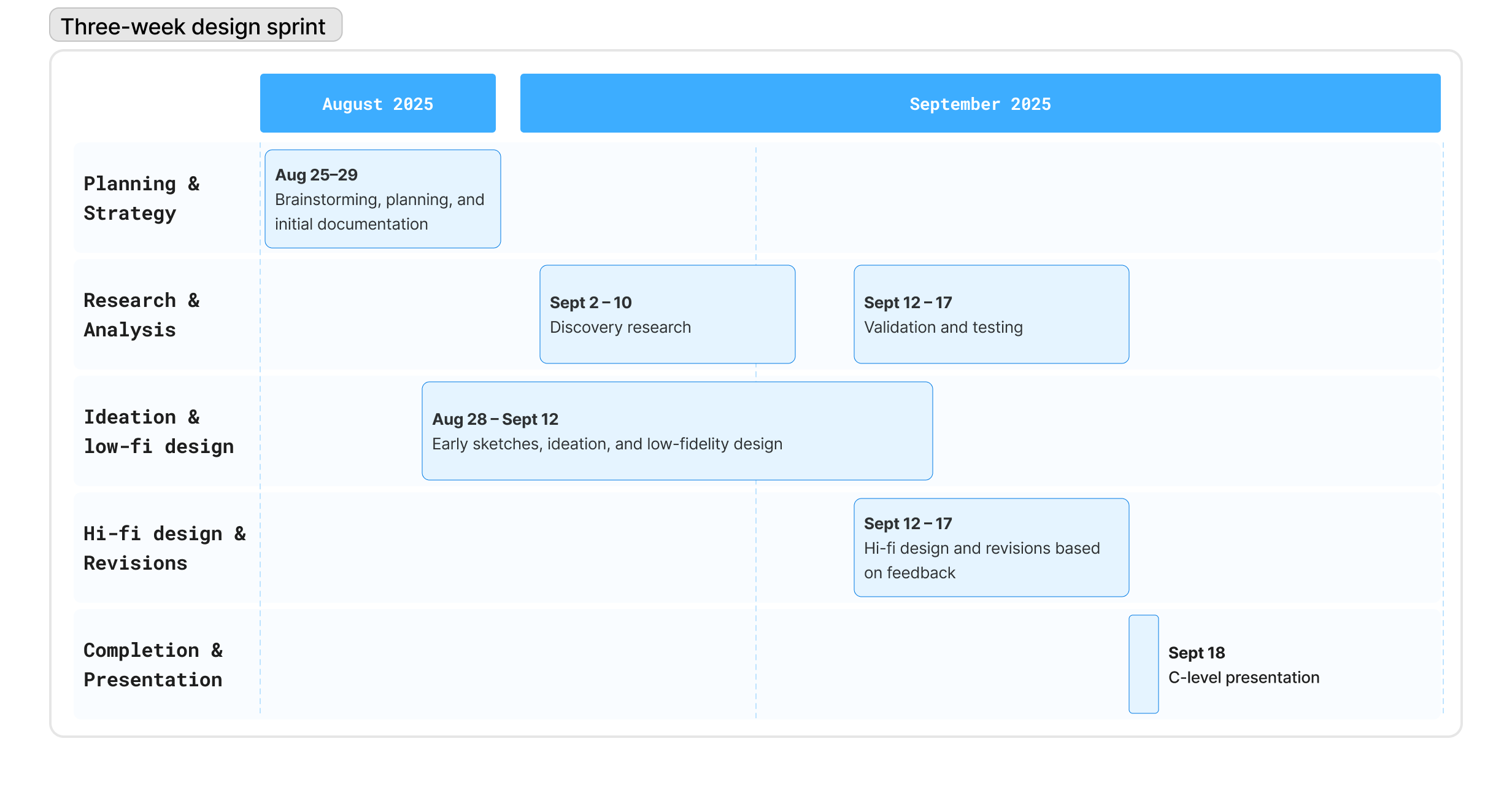
We operated in a tight cadence during a three-week design sprint: daily design reviews between the Product Designer, Senior Product Manager and me; and every few days, strategic alignment with the VP of Product. My decision rights spanned design direction, narrative framing, and cross-workspace definition. I delegated early explorations, but took a hands-on role in structuring the concept, building high-fidelity screens, and preparing the executive materials.
This was full-field leadership, balancing delegation with direct contribution to accelerate clarity.
The VP of Product's initial ask was intentionally ambiguous: “We need to think about AEs and what the ideal experience should be for them.” She asked the Senior Product Manager and I to begin exploring a new concept, but it quickly became clear the deeper need was to rebuild trust with our own AEs. Internal sales reps often didn’t use many of Clari’s core tools, describing Clari as a “leadership platform” rather than one built for them. Negative feedback wasn’t reaching leadership forums, creating an optimism bias around Guide, the current homepage and dashboard experience.
Non-goals for this project:
Success test: Produce a validated, intuitive concept strong enough to be adopted as the AE North Star vision across Clari/Salesloft leadership as well as the combined board of directors.
Across 13 sessions—four with Competitive Intel, eight with internal AEs, and one external AE—patterns emerged quickly:
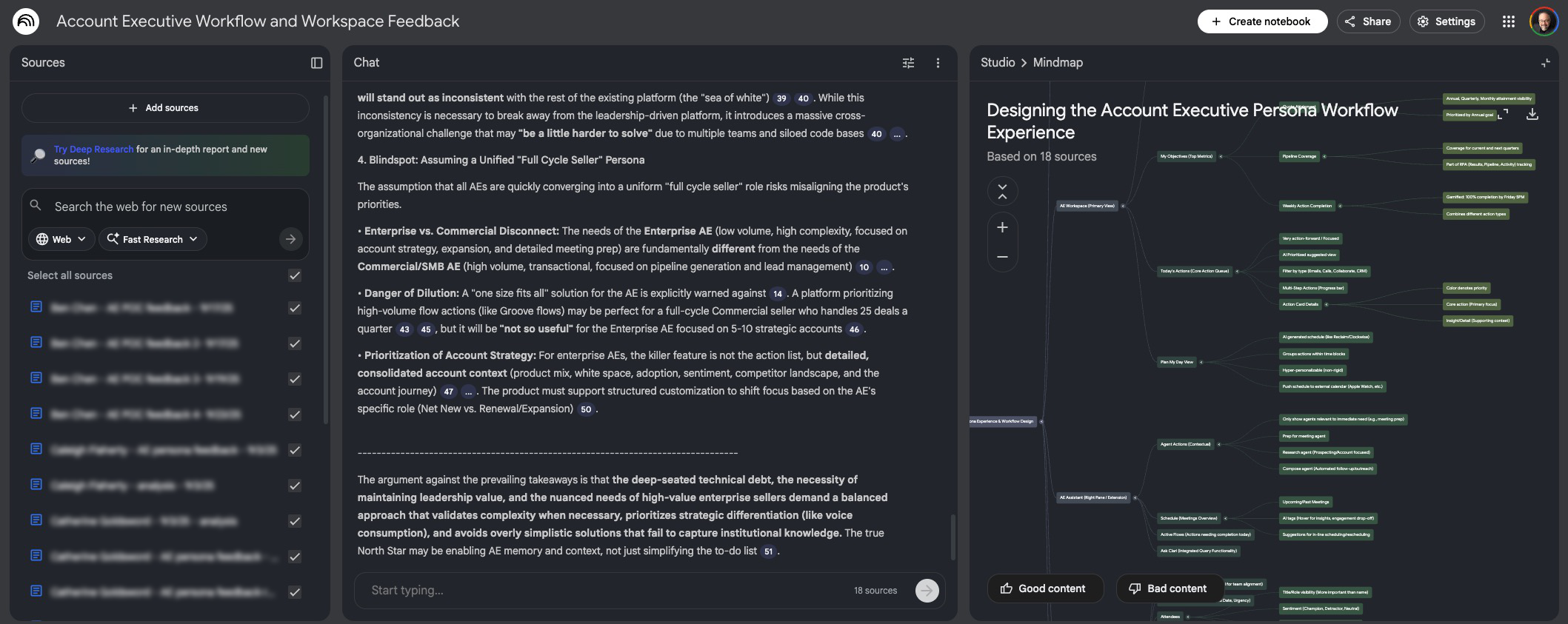
AI-assisted transcript analysis with NotebookLM accelerated my synthesis. Instead of spending hours manually clustering themes, I used AI to pull patterns, identify key decision areas, visualize relationships via mind-maps, and identify core opportunity areas. These insights directly shaped the information architecture by prioritizing action queues, contextual intelligence, and adaptive workflows.
Our design strategy anchored on three principles:
Through continuous feedback, we iterated on how actions were grouped and represented. We evaluated multiple patterns (internal and external) before settling on unified cards with progress indicators and contextual insights that could flex across workflows without fragmenting the experience.
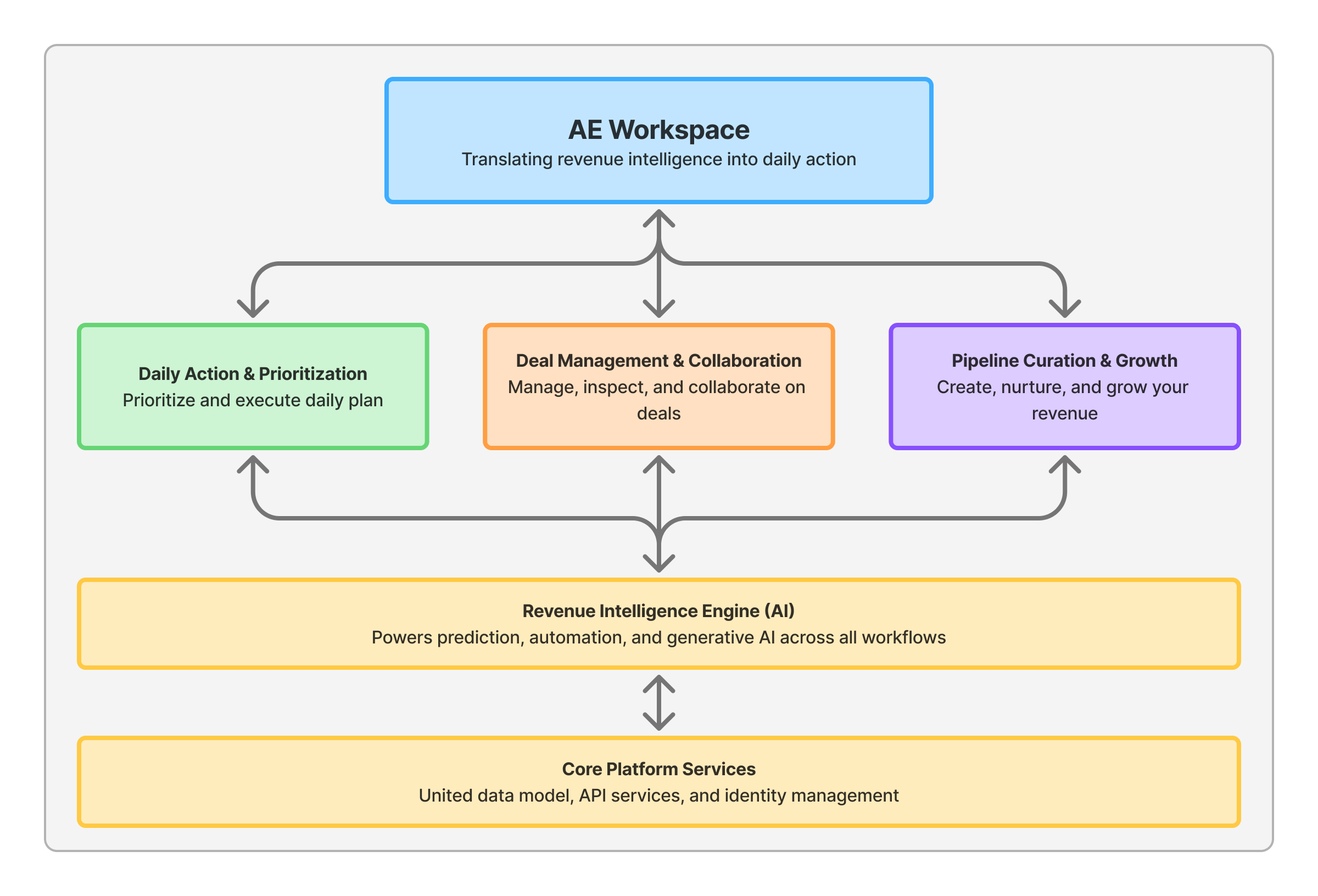
To ensure this approach could scale beyond individual screens, we grounded the UI in a clear conceptual model rather than isolated views. At the top of this model, the AE Workspace serves as the primary action surface, translating revenue intelligence into the decisions AEs make throughout the day.
Beneath that surface, the experience organizes work into three interconnected modes: Daily Action & Prioritization, Deal Management & Collaboration, and Pipeline Curation & Growth. These are not separate destinations. They represent shifts in focus that AEs move between fluidly as their day unfolds, with context preserved across transitions.
All three modes are powered by a shared Revenue Intelligence Engine, which provides prediction, automation, and generative AI consistently across workflows. This layer abstracts complexity away from the UI, allowing insights and recommendations to surface contextually without overwhelming the user.
At the foundation, Core Platform Services support a unified data model, shared APIs, and identity management. This separation of concerns allowed us to move quickly at the experience layer while maintaining long-term scalability and alignment with Clari/Salesloft’s broader platform architecture.
Lastly, we collaboratively mapped a North Star storyboard following an AE through a full day: morning prioritization → meeting preparation → customer conversation → AI-generated summary → post-call actions. Each frame reinforced the value of keeping relevant data, history, and next steps in one place.
In high-level planning for v1, we also expected existing Salesloft and Clari components to play a role, with future iterations moving steadily toward the full AE Workspace vision.
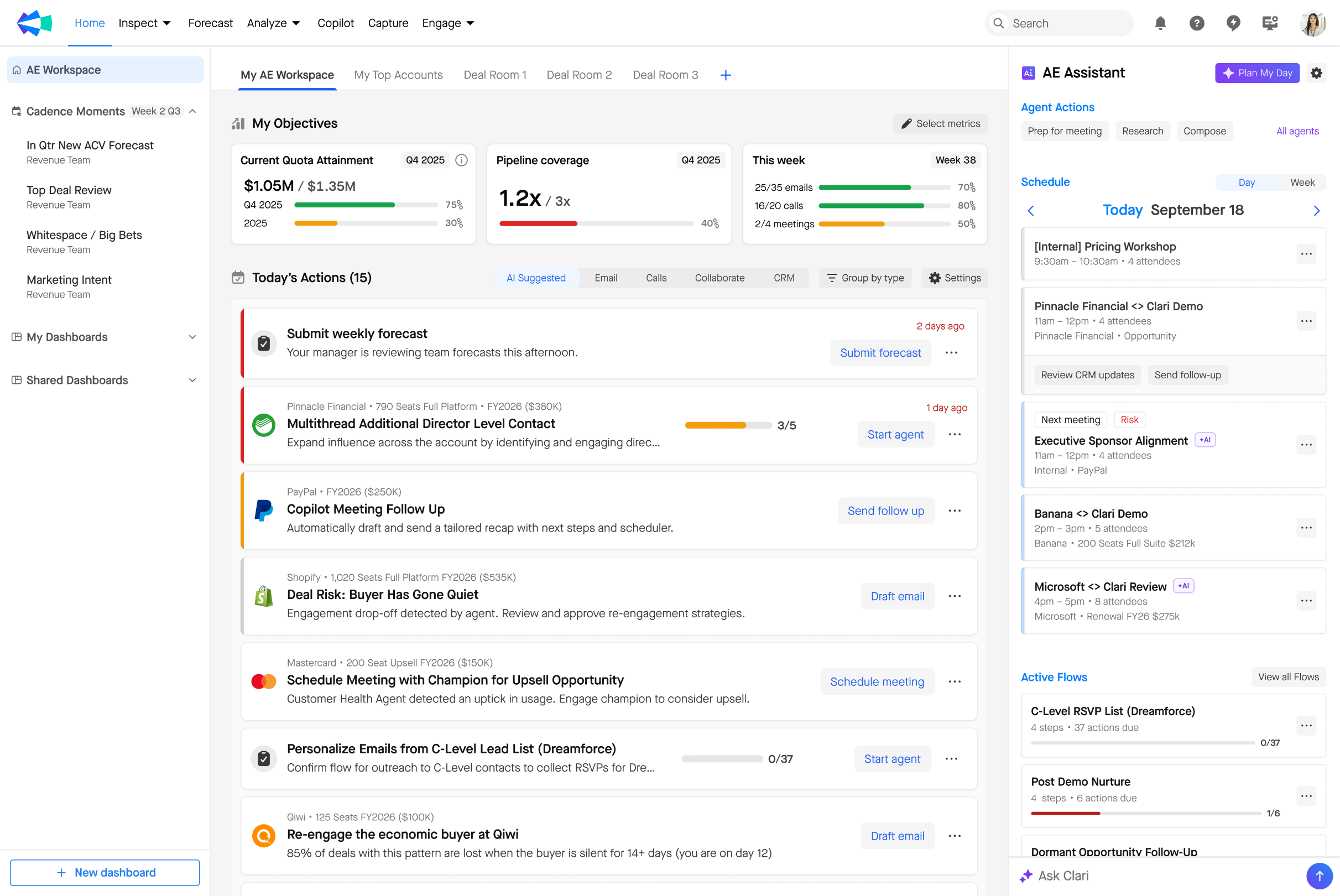
We designed the AE Workspace as a central “sales cockpit” that anchors the AE’s workday. The experience architecture aligned to seven modes of work: morning planning, meeting prep, in-meeting context, outbound engagement, internal collaboration, deal updates, and end-of-day cleanup.
Each mode informed a core capability cluster, including tasking, insights, timelines, account context, and meeting actions. This approach reduced reliance on deeper navigation surfaces within the Clari/Salesloft platform while keeping relevant actions close at hand.
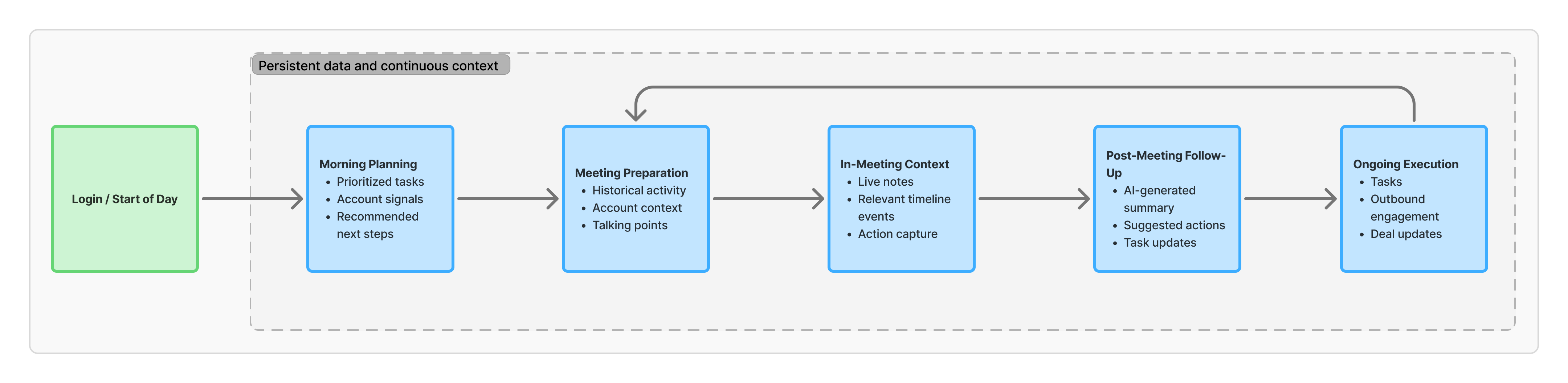
The primary wireflow tracked the AE from initial login through post-meeting actions. We focused on minimizing context switching by surfacing historical activity, recommended next steps, meeting details, and account signals within a single adaptive view.
Craft decisions emphasized hierarchy and clarity. We used grouped action cards, simplified microcopy, selected components from IRIS (Clari's codified design system) for consistency, and subtle mode shifts to signal state without distraction.
We also evaluated two distincct alternatives but chose not to ship them. Expanding RO Workspace for AEs aligned with existing reporting models, but introduced friction by requiring deeper navigation. A dashboard-heavy variant provided comprehensive data, yet violated the action-first principle and increased cognitive load.
The final direction aligned with user needs: speed, clarity, and contextual intelligence.
We ran a three-week sprint with a tight review rhythm. Daily critiques with the Product Designer and Senior Product Manager ensured rapid iteration, while periodic alignment with the VP of Product kept the work strategically grounded and prepared for executive review.
Focusing on design strategy, I also led with a risk-first approach. One of the largest anticipated risks was confusion between Account Executive (AE) and Revenue Orchestration (RO) Workspaces. This surfaced early and I resolved it through the “daily flow vs. deep work” framing, which became foundational to the experience model. At a high level, this meant that approximately 60-80% of an AE's time is spent on day-to-day task and preparation work, versus the remaining time in a deeper focus state, typically inspecting opportunities or communicating with team members in weekly/monthly/quarterly business reviews.
Quality safeguards included consistent use of the Clari IRIS design system, meticulous annotation of states and behaviors, and structured critiques focused on reducing cognitive load. Despite the pace, this ensured conceptual integrity.
We proceeded in a scrappy, high-velocity manner by building first, validating quickly, and course-correcting as needed. Waiting for formal alignment would have slowed progress; instead, the concept itself served as the catalyst for alignment.
Rather than producing exhaustive flows, we focused on a small set of high-impact visual artifacts that could communicate the experience model, resolve key risks, and support executive review. Each artifact was designed to represent a critical moment in the AE’s day and demonstrate how intelligence, context, and action converge within a single workspace.
This primary surface translates revenue intelligence into prioritized actions, live context, and recommended next steps without requiring navigation.
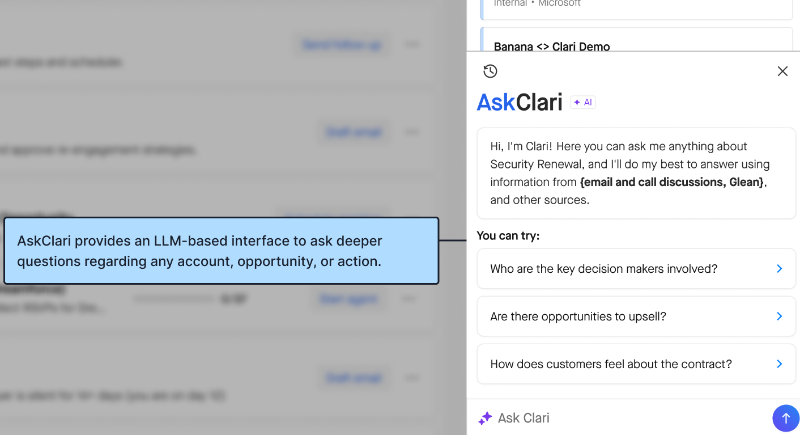
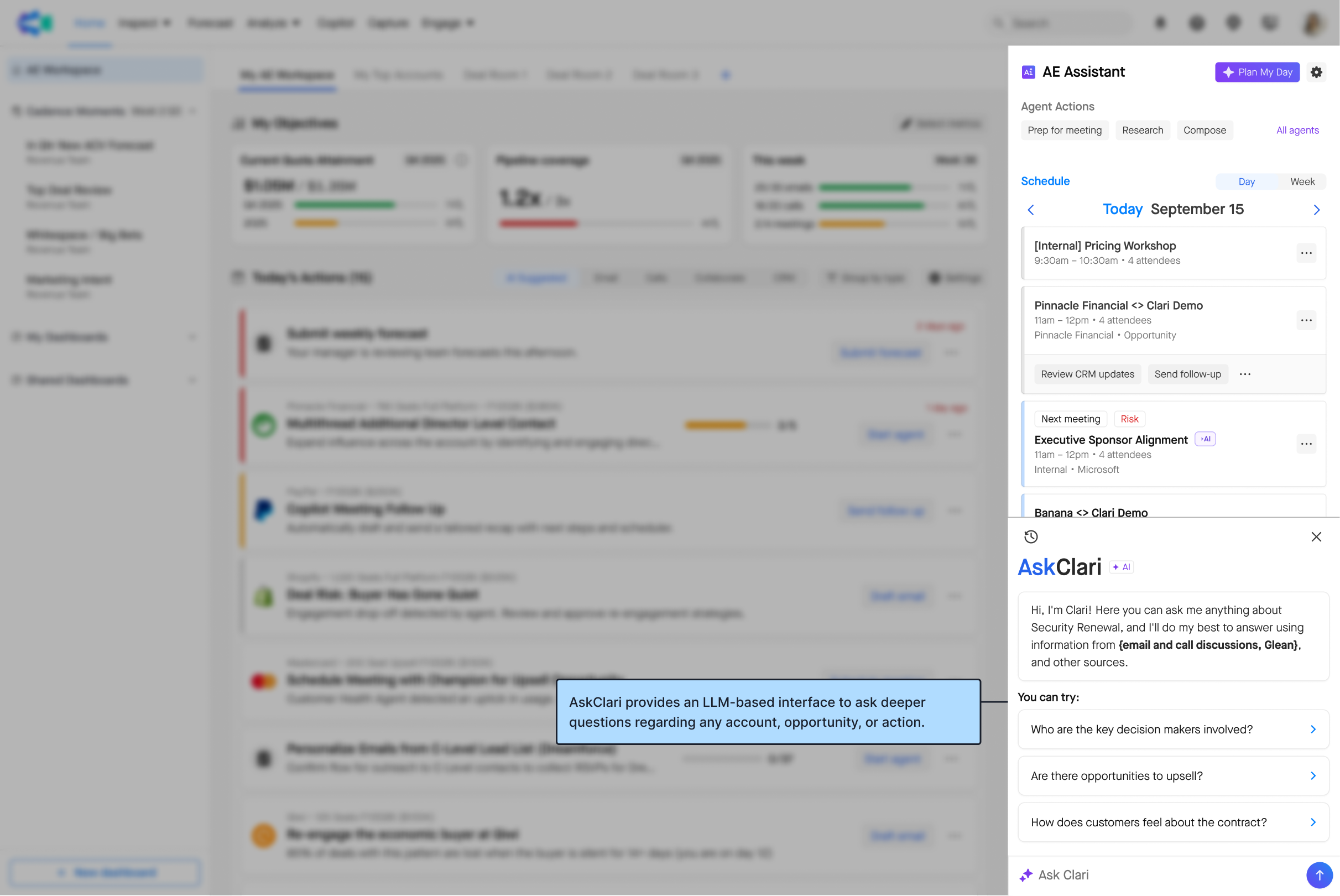
The contextual assistant is embedded within the workspace to surface recommendations, summaries, and answers in context—supporting execution without breaking flow.
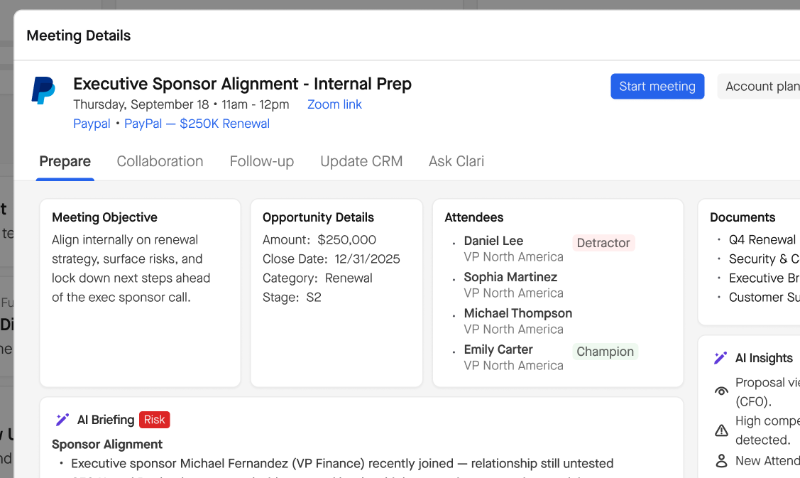
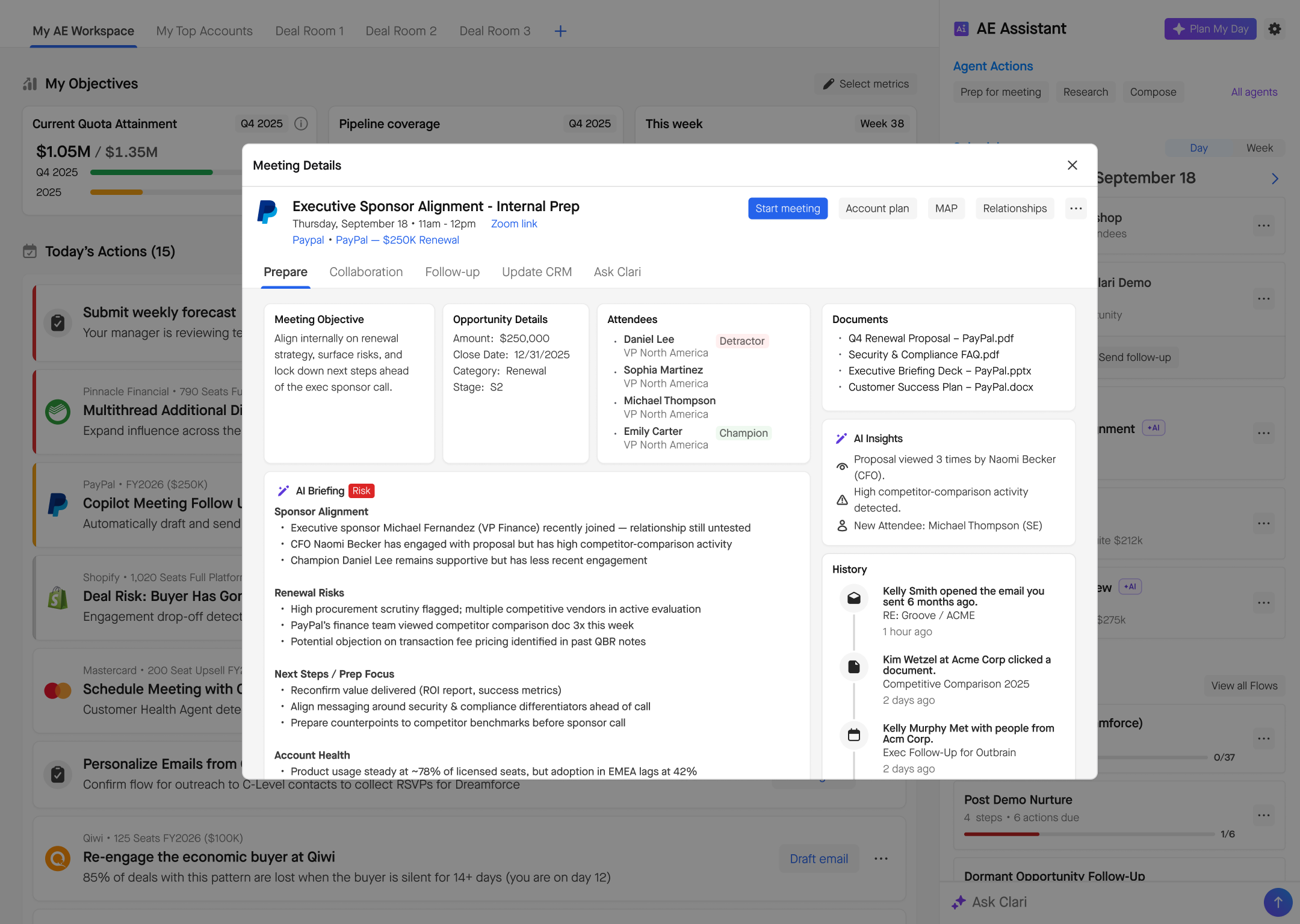
Meetings open as a modal layered over the workspace, preserving access to tasks, history, and next actions before, during, and after the conversation.
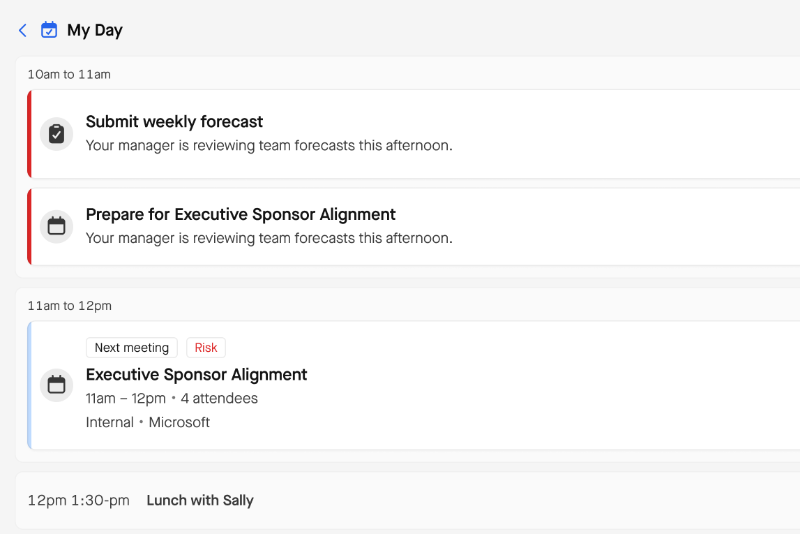
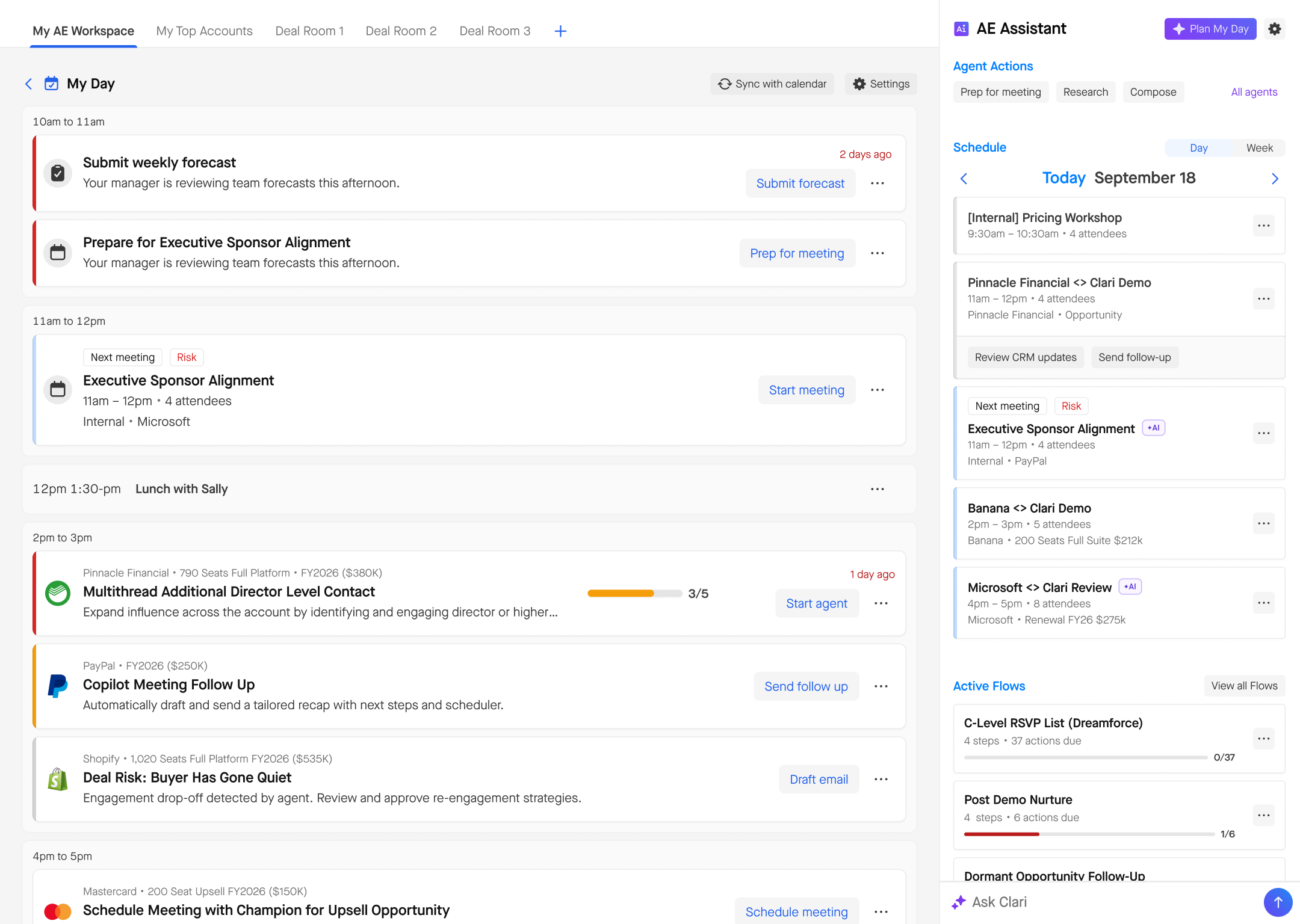
A reconfigured view of the primary workspace that combines meetings and action items into a single planning timeline, demonstrating flexibility without creating a separate destination.
We also explored how the AE assistant could extend into browser (via Chrome extension) and mobile contexts to support sellers between sessions, without fragmenting the core experience. These additional screens (not shown) provided a similar experience without reducing functionality.
Internal Account Executive (AE) feedback validated the direction because the distinction between daily action and deep inspection was immediately clear. Sales reps understood the intent: less navigation and more action. The VP of Product additionally relayed positive feedback from leaders on the Salesloft side of the organization, the CEO, and board-level participants. The concept required minimal explanation and mapped cleanly to how Salesloft thinks about seller workflows.
Because this was a vision initiative, outcomes were measured through alignment rather than metrics. The AE Workspace became referenced as a key component of the unified sales-engagement direction for Clari/Salesloft.
As tensions rose between the AE Workspace and RO Workspace initiatives, I reframed the conversation from ownership to user value. By defining the boundary between daily flow and deep inspection, I provided a shared model that helped both teams see their work as complementary rather than competitive. This clarity reduced friction and enabled faster alignment across product leadership.
With ambiguity high and timelines short, I made the decision to move forward without waiting for formal approvals. Building tangible concepts early gave Account Executives, Product Managers, and Executives something concrete to react to. This judgment call prevented delay and created momentum at a critical moment.
I modeled a modern, accelerated research → insight → concept loop using AI-driven transcript analysis. This demonstrated that rigor and speed can coexist and helped the team recalibrate expectations around how quickly insights can drive strategy. It raised the bar for how we synthesize learning across the organization.
I would incorporate external AE feedback earlier to validate the breadth of workflows across different selling motions. While internal AE validation was strong, external voices would have added more nuance up front. Ultimately, scheduling external AEs across customer organizations required a greater amount of cross-functional communication and time and should have started earlier.
I would also introduce lightweight metrics to measure friction reduction—steps removed, time-to-action, and perceived clarity. These signals weren’t necessary for executive alignment, but they would strengthen the transition into roadmap planning and future validation cycles.